
Fixed-Income and Variable-Income Investments: Which Is Better for Beginners?
If you’re new to investing and want as little room for error as possible, here’s the short answer: fixed-income investments are usually the easiest place to start because they come with a return formula agreed upon when you invest; variable-income investments usually come later, once you’re comfortable with price swings and understand that higher returns always bring greater risk. This article compares the two investment classes to explain when each one may make sense, without pretending there’s one universal “best” choice.
Key takeaways
- Fixed-income investments are usually the first step for anyone who wants fewer surprises at the beginning because the return formula is agreed upon when they invest.
- Variable-income investments make more sense when you’re comfortable with fluctuations and have a longer time horizon, since prices can move significantly before the results show up.
- Don’t treat fixed-income investments as risk-free: their prices can fluctuate before maturity, and credit risk still exists.
- Before investing, compare 3 practical factors: liquidity, time horizon, and taxes, because they affect how much money you get back.
- If you may need the money within a few months, choose more predictable investments; if your time horizon is longer, variable-income investments may make more sense as a smaller portion of your portfolio.
How fixed-income and variable-income investments differ
A fixed-income investment is one where the return, or the formula used to calculate it, is known when you invest, as explained by the gov.br Investidor. Variable-income investments work differently: returns aren’t guaranteed, and an asset’s price can move up or down with the market, supply and demand, and the company’s performance.
In practical terms, the investing experience is very different. With fixed-income investments, it’s easier to estimate what you’ll receive if you hold the security until maturity. With variable-income investments, you buy today without knowing what the asset will be worth a few months or years from now. That applies to stocks, real estate investment funds, and cryptocurrencies.
This is where beginners often make a classic mistake: assuming fixed income means zero risk. It doesn’t. Fixed-income securities and funds can also fluctuate before maturity, especially in the secondary market, where trading prices respond to interest rates, time to maturity, and market expectations. The predictable part is the agreed-upon formula, not the market value from one day to the next.
The examples make the distinction easier to remember. Tesouro Direto, CDBs, LCIs, and LCAs are common fixed-income investments. Stocks, real estate investment funds, index funds, and cryptocurrencies belong to the variable-income category, where prices tend to react much more strongly to market sentiment and the asset’s performance.
How price, risk, and return behave in each investment class
| Comparison criterion | Fixed income | Variable income |
|---|---|---|
| How the price moves | It may fluctuate before maturity, but the return terms are known when you invest | It fluctuates constantly based on market conditions, performance, expectations, and liquidity |
| Main risk | Issuer credit, mark-to-market risk, maturity, and liquidity | Price volatility and the potential for significant losses over the short and medium term |
| Return | More predictable, especially when held to maturity | Not guaranteed and may be negative during difficult periods |
| Examples of instruments | Tesouro Direto, CDBs, LCIs, LCAs, and fixed-income funds | Stocks, real estate funds, index funds, and cryptocurrencies |
The table’s main point is straightforward: predictability doesn’t remove risk; it changes the kind of risk you take. With fixed-income investments, investors often make fewer mistakes by holding the security until maturity, because the contracted return matters more then than the daily price movements.
With variable-income investments, the price is part of the deal from day one. You can own a strong asset and still watch its value drop for months. That doesn’t automatically mean the investment failed. It means the market wasn’t willing to pay the price you expected at that moment.
Which products exist in each class and who they tend to make the most sense for
- Fixed income: Tesouro Direto, CDBs, LCIs, LCAs, and fixed-income investment funds. It tends to make the most sense for people who want predictability, an emergency fund with appropriate liquidity, or goals with a defined time frame.
- Variable income: stocks, real estate funds, index funds, and cryptocurrencies. It tends to make the most sense for people who accept fluctuations and have a longer time horizon, because the money needs time to absorb volatility.
- Your profile and goal matter more than the label. If you may need the money in the short term, the priority is usually liquidity and less price volatility. If the time horizon is long and the investor can tolerate fluctuations, equities can be added gradually.
- A common beginner mistake is using a highly volatile asset for money that may need to be withdrawn within a few months. People who do this often sell at the worst time, not the best one.
It’s also important to separate a product from an asset class. An investment fund may hold fixed-income securities or equities, depending on its portfolio policy. The product’s name doesn’t tell you enough by itself, so read the fund fact sheet and prospectus, then check which type of asset makes up most of the portfolio.
Costs, taxes, and liquidity: what to compare before investing
The investment that looks more profitable on your screen may leave you with less money after taxes, fees, and the redemption period. Liquidity tells you how quickly the money becomes available again. A lockup period is the time when withdrawals aren’t allowed. The term is the date when the investment matures or becomes available for withdrawal. Together, these details can completely change how useful an investment is for your cash flow.
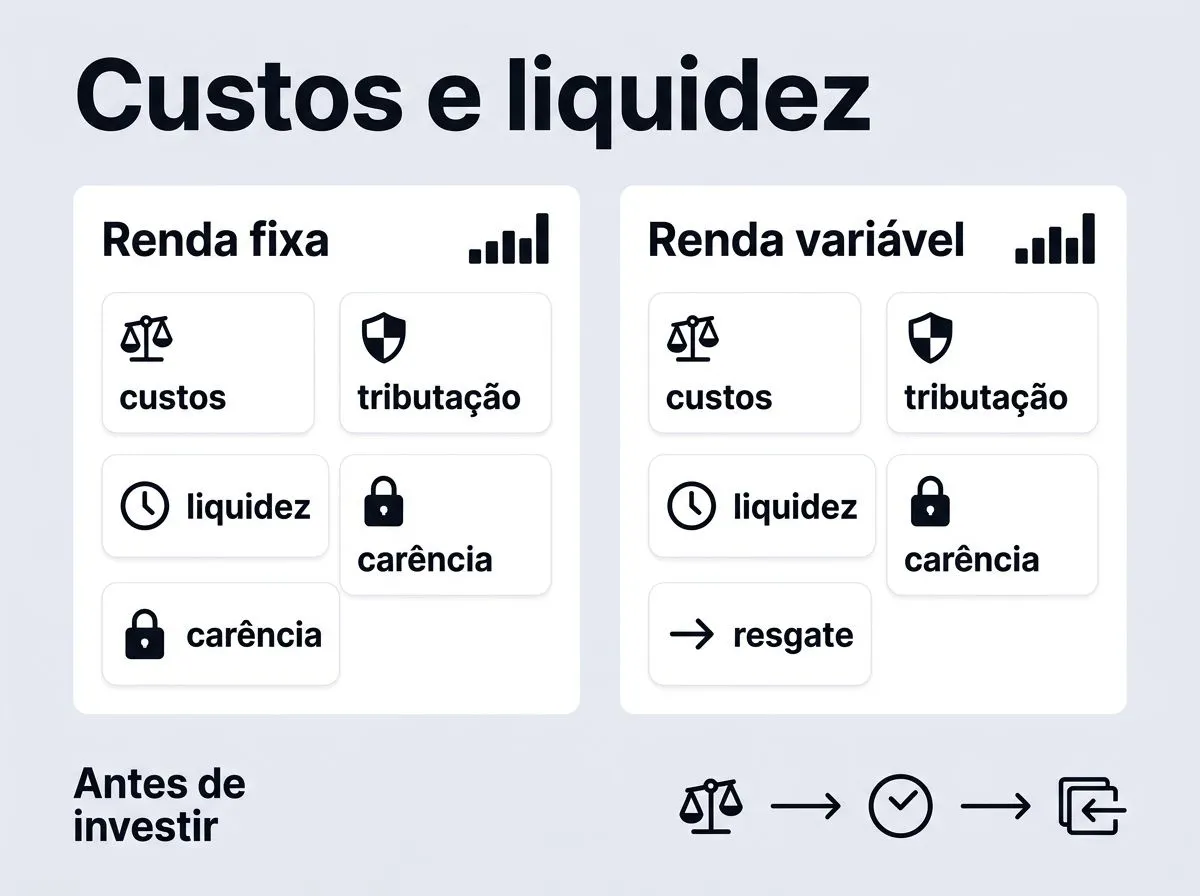
Within fixed income, some products offer daily liquidity, while others keep your money invested until the lockup period ends or the investment matures. CDBs, LCIs, and LCAs can have very different rules depending on the issuer, so review the product page and offering document carefully. With funds, also check the settlement date and when the redemption proceeds are actually paid.
With equities, the price on your screen isn’t necessarily the investment’s final cost. Brokerage commissions, exchange fees, and, for some products, management fees may apply. For mutual funds, index funds, and real estate funds, the fee structure can make a noticeable difference to your net returns over time.
Tax treatment also varies from one investment to another. Tesouro Direto, CDBs, and funds follow their own rules, while stocks and real estate funds receive different tax treatment. Tax rules can change, and the details depend on the product, so verify the information with an official source before investing, including materials from the Ministry of Finance, gov.br Investidor and the issuer’s or fund manager’s own website.
For beginners, the most expensive mistake is looking only at gross returns. The real question is how much you keep after costs and whether you might need to sell early. If the money has a specific purpose, the investment term and lockup period matter more than a promise of a higher rate.
How to read fixed-income prices without falling into a trap
In fixed income, beginners should know that a bond can have a clean price and a dirty price. The clean price shows the bond’s value without accrued interest, while the dirty price includes that interest. The ANBIMA covers this topic in its guidance on pricing fixed-income securities.
This distinction matters because an investor may see a “higher” price and assume the security has become more expensive. Part of that amount may simply be accrued interest. If the investor sells before maturity, mark-to-market pricing also applies. The traded value reflects current market conditions, not only the rate agreed upon at purchase.
In practice, this matters most for people who plan to sell a security early. It matters less for investors who intend to hold it until maturity. The beginner’s rule is simple: if you can’t explain why a bond’s price moves up and down, don’t base your investment decision on short-term fluctuations.
So, what is the best option for getting started?
For most beginners, fixed income is a sensible place to start. It helps you build good habits and learn how liquidity, time horizon, and taxes work without the daily price swings of stocks or cryptocurrencies. That doesn’t mean giving up variable-income investments. Start with a foundation you can explain clearly after you make the purchase.
If you’re building an emergency fund, the priority is usually a fixed-income product with suitable liquidity. Someone investing for a horizon of several years might add a small allocation to stocks or index funds after learning the basics of risk and price movements. Jumping into variable-income investments before understanding your own time horizon often ends with a rushed sale during the first downturn.
The best choice, then, isn’t the asset class that “promises more.” It’s the one that fits the money you have and what you’ll need it for. Start with fixed income, read the product rules carefully, and consider variable-income investments only when you genuinely accept that a displayed price doesn’t guarantee a particular result. That order makes the learning process clearer and cuts down on avoidable mistakes.
Frequently asked questions
Can I start with fixed income alone and move into variable-income investments later?
Yes. For beginners, fixed income can serve as a practical foundation for learning about time horizon, liquidity, and taxes before taking on larger price swings. The article recommends making the transition gradually, especially once an investor can explain why they’re buying each product and how long they can leave the money invested.
Does variable income always produce higher returns than fixed income?
No. Variable-income investments may produce higher returns over longer periods, but they can also stay negative for months or years. As the article explains, that applies to stocks, real estate funds, index funds, and cryptocurrencies. Results depend on the asset, the time horizon, and market conditions, so a positive return is never guaranteed.
Is Tesouro Direto always safer than a CDB?
Not necessarily. Both are forms of fixed income, but the level of risk depends on the issuer, time horizon, and liquidity. Prices can also move before maturity. The article makes another practical point: safety depends on reading the product’s terms, not simply relying on its investment name.
Which matters more for a beginner, liquidity or returns?
If you may need the money soon, liquidity deserves more attention. The most expensive mistake is locking up capital you might need to withdraw early. With a longer time horizon, returns matter more, but risk, taxes, and any lockup period still need to be considered. At the start, the priority is matching the investment to the money’s intended use.