
What Are ETFs and Why Are They Ideal for Diversification
An ETF is an index fund whose shares trade on an exchange. In practical terms, you buy one share and get exposure to a basket of assets that may track the Ibovespa, the S&P 500, fixed-income securities, gold, or another index chosen by the fund. This article doesn't cover leveraged ETFs or traditional actively managed funds. The aim is to understand this basic investment vehicle and see how it can diversify a portfolio with more transparent costs.
Key takeaways
- ETFs trade on an exchange and settle on D+2 at B3, so your money is not available immediately.
- In addition to the expense ratio, compare the bid-ask spread, brokerage fees, and tracking error before buying.
- An ETF diversifies your portfolio only if it adds new exposure, rather than another security similar to one you already own.
- Your choice depends on the index, such as the Ibovespa or the S&P 500, which determines the risk added to your portfolio.
What Is an ETF and How Does It Work in Practice
An ETF is an investment fund whose shares are bought and sold on an exchange, much like a stock. The difference is straightforward: an ETF doesn't represent one company. It represents a portfolio built to mirror a benchmark index.
That changes the investor's experience from the very first click. Instead of building a position one security at a time, you buy a single share and gain indirect access to multiple securities, sectors, or even countries, depending on the index the fund follows.
On B3, shares of ETFs invested in equities, are traded in the regular market, and their prices move throughout the trading session. B3 states that settlement takes place on D+2, meaning two business days after the trade. That detail matters when you're planning when money will enter or leave your account, as well as when it will become available.
The practical takeaway is simple: an ETF gives you fast access to a basket of assets, but it doesn’t remove risk. When the index drops, the share price will usually drop too. Diversification keeps you from relying on one asset, yet your investment still depends on how the asset class you chose performs.
ETF vs. Traditional Mutual Fund: What Changes in Management, Trading, and Costs
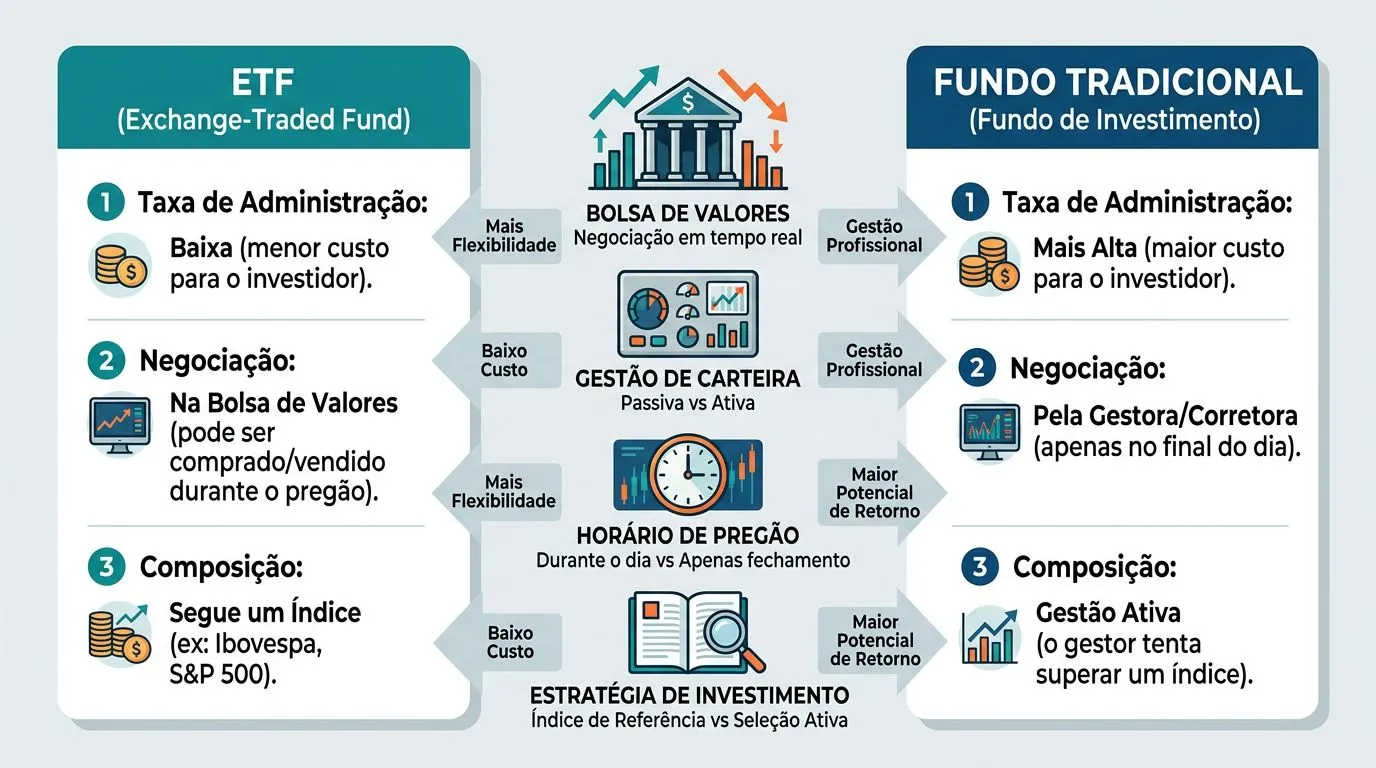
| Criteria | ETF | Traditional fund |
|---|---|---|
| Management | Generally follows passive management and tracks an index | May be passive or active, with more discretionary decisions by the fund manager |
| Trading | Bought and sold on an exchange during trading hours | Invested in and redeemed directly through the fund manager or distributor |
| Price | Changes throughout the day based on supply and demand | Share price calculated during a defined window, usually at market close |
| Liquidity | Depends on trading volume and the bid-ask spread | Depends on the fund’s share-pricing and settlement period |
| Costs | Management fee, spread, and possible operating costs | Management fee, performance fee in some cases, and other fund expenses |
For beginners, the biggest difference is how each investment works day to day. With an ETF, you choose the order price in your brokerage account and buy during market hours. With a traditional fund, you submit an investment request, wait for the share price calculated on the processing date, and then follow the result. That delay between placing the order and knowing the share price affects how you enter and exit the position.
ETFs usually have leaner costs, but they aren’t automatically cheaper in every situation. A traditional fund may charge a higher management fee and, in some cases, a performance fee. An ETF builds its costs into the product structure. You also need to account for the bid-ask spread, brokerage commissions, and how closely the fund tracks its index.
In practice, the right choice depends on your goal and your investing habits. If you want fast, transparent exposure to a market or index, an ETF may be a good fit. If you prefer active management or specific rules for investing and redeeming shares, a traditional fund may suit you better.
How to read an ETF’s costs without falling into traps
- The management fee is the most visible cost, but it does not tell the whole story. It pays for managing and operating the fund, and it is useful for comparing similar products, not for making the decision on its own. An ETF with a low fee can still be expensive if it has a wide spread or tracks its index poorly.
- The spread is the cost built into the gap between the buying and selling prices. When an ETF trades infrequently, that difference can widen and eat into your returns as soon as you enter or exit the position. This matters more for small orders and less-liquid products.
- Tracking error shows how far an ETF strays from the index it is supposed to follow. The smaller the deviation, the better the tracking. For beginners, this figure is a useful quality signal because an ETF that is cheap but tracks its index poorly can disappoint investors who expect to match the index.
- Brokerage commissions, currency conversion costs, and any fees charged by the brokerage become part of the calculation depending on how you buy the ETF and what type of ETF it is. If the fund is tied to a foreign market, currency exchange can become a significant cost. On B3, investors see part of this reflected in the price. In practice, the final bill should account for the entire transaction.
- The right approach is to add everything up: the management fee, spread, brokerage commission, currency conversion, and tracking error. If you look at only one figure, you may choose the wrong product simply because it appears cheaper on paper.
How to assess whether an ETF truly diversifies your portfolio
An ETF adds real diversification only when it brings new exposure to your portfolio. Start with the index it tracks. An ETF that follows the Ibovespa gives you a concentrated sample of Brazilian stocks. One that follows the S&P 500 gives you exposure to large U.S. companies. The index name tells you a lot about the risk you’re taking on.
Then look through the holdings. Two ETFs can appear different while owning many of the same assets, sectors, or currencies. This often happens when investors buy several stock ETFs that end up leaning heavily toward technology, banks, or consumer companies. You may own more funds, but your portfolio isn’t necessarily more diversified.
The asset class matters, too. Stocks, fixed income, real estate, and commodities can react differently to interest rates, inflation, and economic growth. That’s where ETFs can be especially useful for diversification. They allow you to combine different types of risk without buying dozens of individual assets.
Beginners often make the same mistake under different fund names: they repeat the same risk. Buying two U.S. stock ETFs usually adds less protection than combining a stock ETF with a fixed-income ETF, for example. Before buying that second fund, compare its index, sector exposure, currency, and concentration. Those details will tell you whether it actually adds something new.
An ETF can serve as the backbone of a simple portfolio, or it can complement one that already holds traditional funds, fixed income, and individual stocks. Popularity shouldn’t make the decision for you. The real question is whether the fund adds exposure you don’t already have and that you genuinely want to hold for your chosen time horizon.
What to check before buying your first ETF
- Check which index the ETF tracks and review the portfolio holdings. The fund’s name alone is not enough to tell you where the risk lies.
- Check trading volume during the session and watch the spread. If the product trades infrequently, you may pay more to get in and out.
- Compare the management fee with the tracking error and the total cost of the transaction. The ETF with the lowest advertised fee is not always the most cost-effective choice.
- Understand D+2 settlement and how your brokerage works so you do not confuse an executed order with funds that are available.
- If your goal is portfolio protection, choose the ETF based on the role it plays, not on the current hype.
To get started safely, review the product documentation on the B3, asset manager, and brokerage websites. Companies such as BlackRock, Banco do Brasil, XPI, and StoneX offer useful educational materials on how ETFs work. Still, a sound decision starts with reading the index, evaluating the total cost, and deciding what role the ETF will have in your portfolio.
In practical terms, an ETF gives you a straightforward way to buy diversification through exchange trading. It can be a good fit if you want broad exposure, transparent costs, and control over when you enter and exit. It makes less sense if you need active management, specific redemption rules, or a risk profile that differs significantly from the chosen index.
Your next decisions are pretty clear: choose an index that matches your goal, compare the total cost instead of focusing only on the management fee, and check whether the ETF actually adds new risk to your portfolio. Answer all three questions before buying, and you're far less likely to make an impulse purchase.
Frequently asked questions
Does an ETF automatically pay dividends?
Not always. Some ETFs distribute income to shareholders, while others reinvest those earnings within the fund. The product's policy and structure determine what happens, so check the fund prospectus before you buy.
Can you buy an ETF with a small amount of money?
Yes, provided the price of one share fits your budget and your brokerage allows purchases in the minimum lot or through a fractional order. Since the share trades on an exchange, the amount you need to get started depends on the ETF's market price, rather than a high minimum investment required by some other products.
Is a foreign ETF the same as an ETF listed in Brazil?
No. A foreign ETF may trade on another exchange and follow that market's local rules, while an ETF listed in Brazil trades on B3 and follows Brazil's regulatory structure. In practical terms, that affects the exchange where it trades, the reference currency, and often the product documentation.
Can I use an ETF as a short-term investment?
You can, but an ETF usually works better as part of a portfolio than as a very short-term bet. Its share price moves throughout the trading session, and settlement on B3 occurs on D+2. That leaves short-term investors more exposed to price changes and the bid-ask spread. If you plan to trade in and out quickly, those factors can matter more than you'd expect.