
What Is Fixed-Income Investing and How to Get Started Safely
Fixed-income investing is an asset class where the return rules are set when you invest. The return may come from a fixed rate, a benchmark, or a combination of both. For many people, it’s the first step toward more predictable investing, but that doesn’t remove risk or make every product interchangeable. This explanation covers fixed-income securities and funds, not stocks, crypto assets, or other variable-income investments.
Key takeaways
- Returns may be fixed, floating, or inflation-linked, and the practical effect only becomes clear at maturity.
- If you may need the money before the term ends, liquidity matters more than the advertised rate.
- The FGC covers some banking products, up to R$250,000 per taxpayer ID and per institution, subject to the fund's rules.
- CDBs, Tesouro Direto, and fixed-income funds differ in issuer, taxes, costs, and protection, so you should not start comparing them by their gross rate.
- Read the prospectus or fund rules before investing, because redemption terms, fees, and the investment period can significantly change your net return.
What Is Fixed-Income Investing and How Does the Return Work at Maturity?
Fixed-income investing means lending money to a public- or private-sector issuer under a return calculation rule you know in advance. The gov.br Investidor explains that the return can be fixed, meaning the expected amount at maturity is already established, or floating, meaning it follows an indicator.
In practice, fixed-income investments usually fall into three formats. With a fixed rate, you know the nominal rate from the beginning. With a floating rate, the return follows a benchmark such as CDI or Selic. An inflation-linked investment combines a fixed rate with a price index, helping protect your purchasing power through maturity if you hold the security until then.
Maturity or redemption is the key detail. If you hold the investment until the agreed date, the calculation will generally follow the rule set in the contract. Leave early, though, and the price may change as the market reassesses the security based on interest rates, the remaining term, and liquidity. This catches many investors off guard: predictable terms don’t mean the price remains unchanged along the way.
That detail should shape what you buy. If you’ll need the money soon, daily liquidity or a short term may matter most. If you can wait until maturity, you might accept less flexibility in exchange for a clearer return. A classic beginner mistake is focusing only on the advertised rate and overlooking the term, redemption rules, and what happens if you need to sell early.
How to Compare CDBs, Tesouro Direto, and Fixed-Income Funds
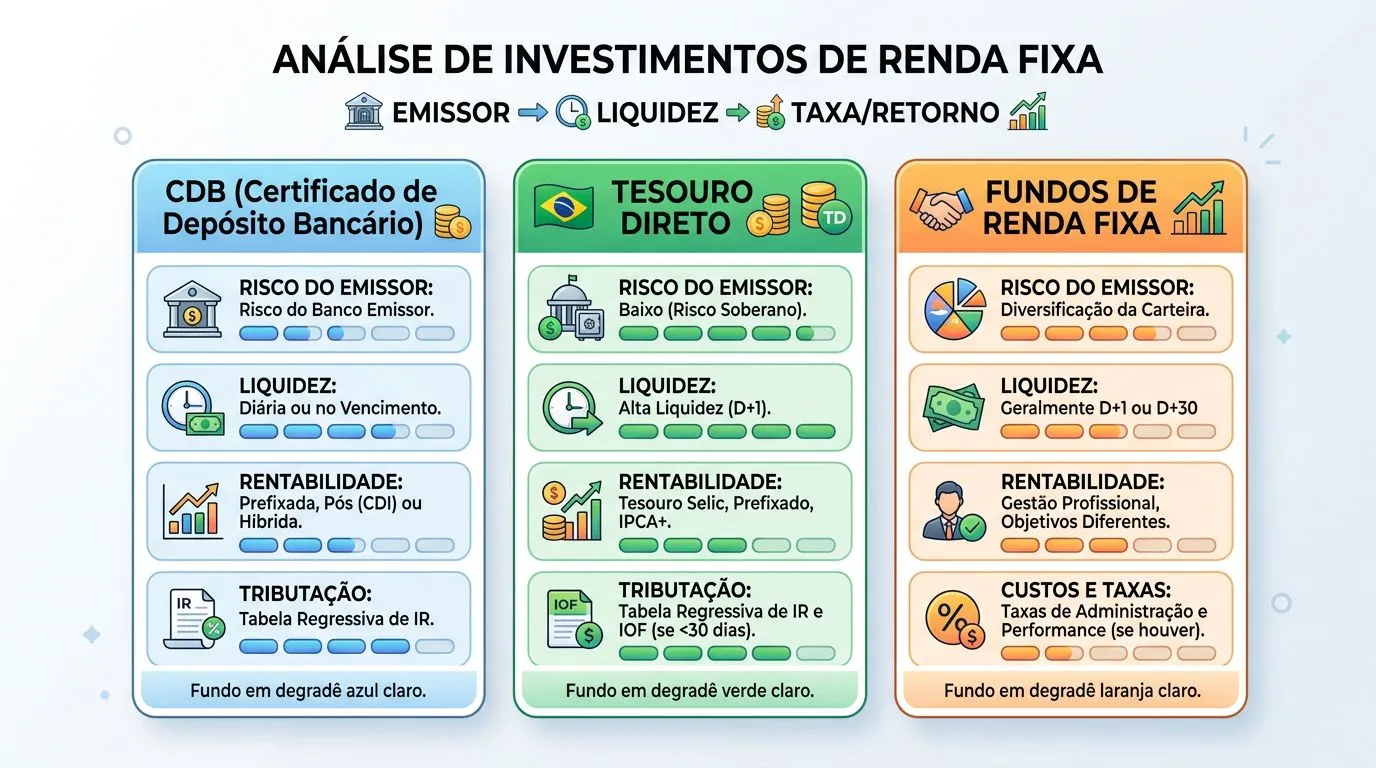
| Product | Credit risk and issuer | Liquidity and redemption term | Taxation and tax treatment | FGC protection | Fees charged and their impact on net returns |
|---|---|---|---|---|---|
| CDB | Credit risk of the issuing bank. If the bank does not pay, the risk falls on the issuer. | It may offer daily liquidity or have a fixed maturity; read the contract terms. | It follows the regressive income tax schedule for individual taxpayers, when taxable. | It may be covered by the FGC, subject to the applicable rules and limits. | There is usually no management fee for individual investors; the impact comes from the spread embedded in the offering. |
| Tesouro Direto | Sovereign credit of the federal government, sold through the government program. | Some bonds offer daily liquidity through sales back to the Treasury; the price may fluctuate before maturity. | It follows the fixed-income tax rules for individual taxpayers, when applicable. | It is not covered by the FGC. | The platform may charge a fee, in addition to B3's custody fee, which affects net returns. |
| Fixed-income funds | The risk comes from the fund's portfolio and the assets it holds. | Redemption depends on the fund's rules and type; some offer D+0, D+1, or longer settlement periods. | Tax is assessed based on the fund's structure and share transactions, under its own rules. | They are not covered by the FGC. | They charge a management fee and, in some cases, a performance fee, which reduces the net return. |
Start the comparison with the issuer. Then look at liquidity, and only after that compare rates. A CDB might look better because it displays a higher percentage, but your money could remain locked up longer. A Tesouro investment may seem simpler, yet the net rate changes after custody fees and taxes. A fund can work well for investors who want professional management, provided the fees don’t take too much of the return.
For an emergency fund, liquidity usually matters more than an extra tenth of a percentage point in interest. Saving for a specific date puts the term and maturity at the center of the decision. And if you’re simply searching for “the most profitable” option, the comparison is incomplete. Gross return doesn’t tell you how much you’ll actually keep after taxes and fees.
What the FGC covers and what it does not
The Credit Guarantee Fund, or FGC, protects certain banking products, but it doesn’t cover every fixed-income investment. Its purpose is to reduce losses if the issuing institution fails, subject to the limits established by the fund’s rules. The public reference from B3 summarizes the basic logic: CDBs, LCIs, and LCAs are generally among the protected instruments, while Tesouro Direto, debentures, CRIs, and CRAs aren’t covered.
The FGC’s best-known limit is up to R$250,000 per CPF and per institution, with an overall cap per period and per conglomerate under the fund’s rules. That limit matters if you place a large amount with one bank. Any amount above the limit wouldn’t be protected, so spreading investments across issuers may make sense for investors who want to diversify credit risk.
Many beginners treat “FGC-covered” as if it meant “risk-free.” It doesn’t. Even within the coverage limit, you face the possibility of credit problems and may have to wait for the guarantee payment. Coverage also doesn’t extend to every product that looks conservative. Tesouro Direto, for example, is backed by the federal government, but it isn’t covered by the FGC.
For beginners, the practical question is simple: who owes me the money? If a bank owes the debt and the product is covered, the FGC belongs in your analysis. If the issuer is the government, a different form of protection applies. For a private security outside the coverage, you also need to examine the issuer’s financial health and how long you’ll wait for redemption.
How to read a prospectus and regulations before investing
- Look for the return index, the rate, and the maturity date because these determine when your money comes back and how it grows.
- Check the liquidity, lockup period, and redemption period, including whether you can exit only on specific dates or whether daily liquidity is available.
- Read the tax rules and the product’s fees, especially management, custody, and any performance fees.
- Review the sections on risks and early-maturity events because they identify the situations in which the rules may change before the final maturity date.
- Find out whether the product is issued by a bank, the government, or a fund, and use that answer to decide whether it makes sense for an emergency fund, a medium-term goal, or money that can remain invested until maturity.
The product description usually names the index near the beginning of the prospectus and regulations. After that, look for the term, calculation method, rate, and exit conditions. Those details can separate a suitable investment from an expensive surprise. Investors who read only the summary offer and skip the full document may discover too late that the product has a lockup period, a quotation period, or a less favorable redemption rule.
If the document discusses returns but doesn’t clearly state the redemption period, you don’t have enough information to decide. An attractive rate can look very different after a significant management fee. And if a product promises simplicity while its regulations specify D+30 redemption or limited redemption windows, it’s a poor fit for money you may need at any time.
How to get started more safely
Start with money that fits this type of investment: your emergency fund, predictable expenses, and amounts you can leave invested until the agreed term ends. That reduces the chance of selling early and accepting a worse price. For a first investment, clear liquidity and simple rules usually make more sense than chasing the highest rate available.
Next, compare the net rate of return. Start with the advertised return, then subtract applicable taxes and factor in any platform or fund fees. For fixed-income investments, a slightly lower return may be the better choice if it gives you more liquidity and costs less. A higher-looking rate isn't much help if your money is locked up and expensive to access early.
If you're still choosing between products, use this order: understand who the issuer is, check the term, review the liquidity, and consider protection last. That sequence helps you avoid picking an investment simply because the name feels familiar. A CDB may fit your needs, Tesouro Direto may fit them too, and a fund may also work, but each serves a different purpose.
Verification Checklist
- The compensation structure should be clear, with the rate, benchmark, and maturity date explicitly stated in the product materials.
- The redemption period or maturity date must match the date when you may need the money.
- The document should make it clear whether FGC coverage applies, whether there is no FGC coverage, or whether another form of protection applies, such as with Tesouro Direto.
- The net-return calculation should account for taxes and fees, and the final amount should still make sense for your goal.
- The regulations or prospectus should clearly state when you can exit, how long it takes for the money to become available, and which conditions could change that timing.
Frequently Asked Questions
What is the difference between gross and net returns on fixed-income investments?
Gross return is what an investment earns before taxes and fees. Net return is what you actually keep after those costs come out. That difference matters with fixed-income investments. A product offering a higher rate can still leave you with less money if taxes, custody fees, or management fees eat into the earnings.
Can I lose money in a fixed-income investment?
Yes, that can happen. If you sell a security before maturity and its market value has changed, you could receive less than you paid for it. There is also the issuer's credit risk. In other words, predictable terms don't mean the investment is risk-free.
Is fixed income suitable for an emergency fund?
It makes sense only when the investment offers liquidity that matches how quickly you might need the money. For an emergency fund, avoid lockup periods and significant volatility. You may need to withdraw the cash before the product reaches its ideal term, and that's a bad time to discover you can't access it easily.
What is mark-to-market pricing?
It refers to the adjustment in a security's price based on interest rates, the time left until maturity, and current market conditions. This matters most if you plan to sell before maturity, since the value can rise or fall along the way. If you hold the security until maturity, the agreed-upon terms generally apply when it matures.