
7 Simple Financial Habits That Speed Up Financial Independence
If you're trying to get out of financial strain and build real financial independence, start by calculating your monthly expenses and finding the leaks in your budget. The basic logic is simple: spend less than you earn, keep an emergency fund in a highly liquid, low-risk account, pay off expensive debt, and only then increase your investments. This guide won't promise a quick path to wealth. It's about creating a financial system you can maintain.
Key takeaways
- If you do not track your monthly expenses, you cannot set a goal, so the first step is to add up your essential and recurring expenses every month.
- Your emergency fund should come before aggressive investments if you do not have expensive debt, because it keeps you from relying on credit when unexpected expenses arise.
- If you have expensive debt, your priority is to stop the bleeding and renegotiate it before increasing contributions to higher-risk investments.
- Small monthly contributions work better than waiting until you have the ideal amount, because they create consistency even during periods of tighter income.
- Reviewing your budget every month helps you cut leaks such as fees, subscriptions, and impulse purchases before they become habits.
What financial independence means and how to measure it against your monthly expenses
Financial independence means having enough resources to cover your basic needs without depending entirely on a fixed income, as defined by the gov.br/investidor. In practical terms, your monthly expenses are the most useful benchmark. How much do you need to maintain the lifestyle you want without going into the red? If you don't track that number, your financial goal stays abstract.
Start by adding up essential expenses, recurring bills, and obligations that can't be paid late. Then compare that total with your take-home pay and available assets. Your salary alone can create a misleading sense of security. Someone who earns well but spends everything is still far from financial independence, while someone with invested assets and controlled spending may be further ahead than they realize.
The content on the gov.br/investidor. It highlights discipline, planning, and determination as the foundation for building this future. That follows common sense: without a regular financial routine, the goal stays vague. Tracking your monthly expenses turns it into a measurable number instead of leaving it as a general wish.
This article doesn't present early retirement as a promise of instant freedom. The focus is more practical: organize your finances so you depend less on credit, face fewer financial surprises, and have more room to invest consistently.
Which financial habits actually build this path in everyday life
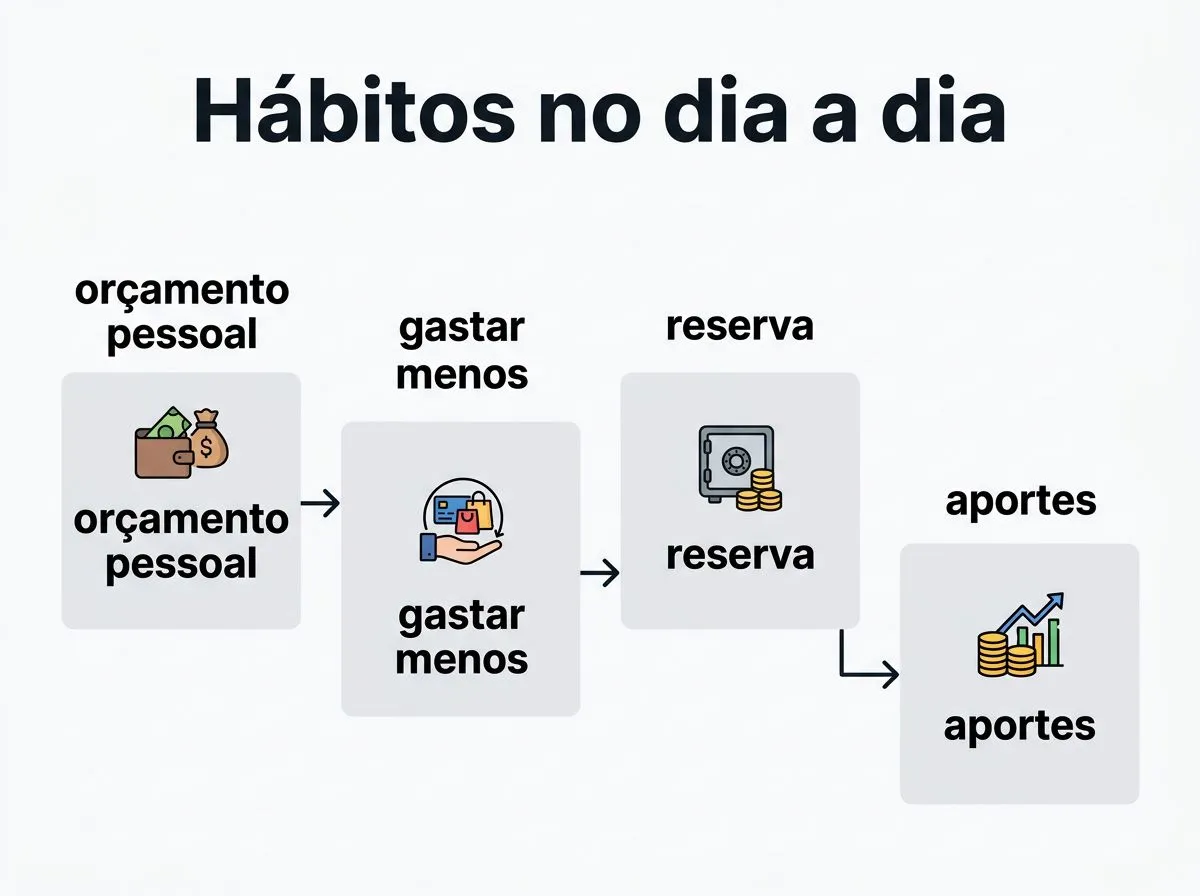
- Spend less than you earn, keeping your standard of living below your take-home pay to make room for emergency savings, debt payoff, and investing.
- Create a personal budget that tracks income, expenses, and total monthly spending, then use that figure as the basis for every financial decision.
- Build and maintain an emergency fund in a highly liquid, low-risk account so you do not have to rely on expensive credit when unexpected expenses arise.
- Invest consistently, even with small contributions, instead of waiting for an ideal amount that may never materialize.
- Review your budget regularly to spot spending leaks and adjust priorities without losing control.
Spending less than you earn is the first habit, and it sounds obvious because it is. Still, many people try to repair their budget by chasing higher income while overlooking their expenses. If your spending climbs with your salary, there won't be much left to build wealth.
The second habit is to treat the budget as a tool. It gives you a clear picture of your actual monthly spending and shows where adjustments are possible. Without that view, you may assume you simply don't have enough money when the real problem is not knowing exactly what comes in and what goes out.
The emergency fund comes next because it keeps the rest of the plan standing. The Financial Education Guidebook from Banco Central do Brasil recommends keeping this money highly liquid and low risk, since an emergency requires quick access without avoidable losses. If your emergency fund is tied up in a risky investment, it may fail you when you need it most.
Starting to invest early helps, but consistency matters more. Small contributions made every month can do more for your plan than waiting for a large amount of money that never becomes available. Build the habit of investing regularly instead of trying to time the market perfectly.
Reviewing your budget keeps the plan current. Forgotten subscriptions, bank fees, impulse purchases, and small overspending can add up quickly when they repeat month after month.
Debt, emergency savings, and investing: Which should come first in each situation
| Financial situation | First step | Second step | When to start investing | Risk of ignoring this order |
|---|---|---|---|---|
| Carrying expensive debt, such as a revolving credit balance or recurring late payments | Stop the bleeding, renegotiate, or pay off expensive debt | Organize your budget and create a small amount of monthly breathing room | As soon as debt stops consuming a large share of your income, even with small contributions | High interest erodes wealth and can wipe out any initial gains |
| No emergency fund, but no expensive debt | Build an emergency fund in a safe, liquid account | Then, start investing consistently as your budget allows | After saving the minimum emergency fund needed for unexpected expenses | Forced withdrawals and reliance on credit during emergencies |
| Emergency fund in place, debts under control, and a predictable budget | Increase contributions and diversify investments according to your goals and timeline | Review your goals and risk tolerance without rushing | Once your financial foundation is stable | Starting too late and losing consistency over time |
The order matters because expensive debt starts costing you immediately, before any investment returns have a chance to work in your favor. Revolving credit, for example, can place one of the heaviest burdens on a budget, and the Central Bank of Brazil It treats this kind of cost as something to eliminate first. If you keep financing purchases at high interest rates, every investment begins with a built-in disadvantage.
Without an emergency fund, the risk simply moves somewhere else. A health, car, or home emergency can force you to withdraw money at the worst possible time or, even worse, take on new credit. That is why an emergency fund comes before sophisticated diversification.
Once the basics are covered, the focus moves to consistency and investments that match the goal. At that stage, rushing usually creates more problems than it solves.
Mistakes That Delay Financial Independence and How to Fix Your Plan
The costliest mistake is allowing high-interest debt to grow while trying to invest at the same time. Revolving credit eats into your cash flow, leaves less room in the budget each month, and pushes your net worth in the wrong direction. If you have expensive debt, focus on stopping the interest from piling up, renegotiating the terms, and restructuring your budget. Opening another financial front can wait.
Another common mistake is trusting a promise that combines high liquidity, low risk, and high returns as though that were the normal market standard. Brazil's own Central Bank of Brazil warns that these three features do not appear together in a legitimate investment offered by a reputable institution. When you see that combination, pause and question it instead of chasing the opportunity.
Investing without an emergency fund creates another problem: an unexpected expense may force you to sell at the wrong time. That becomes especially likely when you haven't built a routine for tracking expenses. Here's a practical warning sign: if you regularly finish the month short, your contributions swing too much, and you use credit for basic expenses, simplify the plan before making it bigger.
If you're looking for practical guidance, the educational pages from [Central Bank of Brazil], from gov.br/investidor, from InfoMoney, from Fast Company Brasil, from Investimentos.com.br, from XPI all return to one straightforward point: discipline comes before speed. That idea holds up because this adjustment closes financial leaks before you ask your money to work harder.
If you want to move toward financial independence faster without losing your footing, keep the plan simple. Control your monthly expenses, stop borrowing to pay for costly consumption, build an emergency fund, and only then raise your contributions. The best pace isn't the most aggressive one. It's the pace you can maintain for years without having to start over.
Frequently Asked Questions
How much of my income should I set aside to start building an emergency fund and investing?
Start with a fixed amount that fits your budget, even if it feels small. The article’s main point is that consistency matters most: a modest contribution every month usually helps more than waiting for an ideal amount that may never come. If your income is tight, review your monthly expenses first and free up whatever room you can.
Can I invest if I have debt?
You can, but the right order depends on how much the debt costs you. Expensive debt, such as a credit card balance or repeated late payments, should come first because high interest can erode your net worth faster than a basic investment is likely to build it. Small contributions are reasonable only if they don’t get in the way of paying off or renegotiating that debt.
What type of account should hold my emergency fund?
Choose an account with high liquidity and low risk. Your emergency fund needs to be available quickly, and without significant losses, when an unexpected expense appears. If the money is locked up or exposed to major fluctuations, it won’t do its job when you need it most.
How can I tell whether my monthly expenses are calculated accurately?
They’re closer to reality when they account for essential expenses, recurring costs, and a cushion for unexpected bills. The article also recommends comparing that total with your take-home pay and available net worth, since salary alone can paint a misleading picture. Leave out any one of those pieces, and your financial independence goal can end up distorted.
What’s the most common mistake people make when they start investing too early?
Starting to invest without an emergency fund or control over debt, especially expensive debt, creates unnecessary risk. An unexpected expense could force you to sell investments at a bad time, while the pressure may lead to rushed decisions. The plan becomes much more fragile when investing begins before the financial foundation is in place.