15 Simple Ways to Save Money Without Changing Your Lifestyle
If your income arrives and vanishes before the month is over, the issue usually has less to do with your salary than with how you think about your money. You can save without overhauling your lifestyle once you understand your personal budget with clarity, plug recurring leaks, and make more deliberate choices about where to keep your emergency fund instead of leaving all of it in a savings account.
Key takeaways
- Over 30 days, track your take-home pay, fixed, variable, and occasional expenses to find out where your money is going.
- Cut automatic charges, fees, and rarely used subscriptions first because they are easy expenses to keep paying.
- For credit card debt, compare the total cost through payoff, not just the monthly payment, before accepting a new repayment plan.
- For your emergency fund, prioritize liquidity, risk, and quick access instead of chasing the highest return.
- If your savings account already does the job, move your emergency fund only when the new product offers practical withdrawals and appropriate protection.
How to Build a Personal Budget That Shows Where Your Money Goes
A useful personal budget starts with your take-home pay and ends with a specific amount left over. “Spend less” is too vague to guide you. If you’re barely getting through the month, this process shows where your money is slipping away and how much you can set aside without throwing off your routine.
- Start with your monthly take-home pay, not your gross income, so you know how much money is actually available.
- Separate expenses into fixed, variable, and occasional costs because each category calls for a different type of control.
- Track everything for 30 days without trying to “clean up” the numbers, so you can identify recurring expenses and small spending leaks.
- Set a practical savings goal before the month ends, based on what remains after essential expenses.
- Close the loop by checking where you overspent, so you can adjust the next month without cutting things that are part of your routine.
Take-home pay is the amount that actually reaches your account after mandatory deductions. Fixed expenses include rent, HOA fees, internet, and school tuition. Variable expenses go in a separate category, including groceries, transportation, and your electricity bill. Occasional expenses follow their own schedule, such as enrollment fees, maintenance, gifts, and IPVA. Separating expenses this way helps you avoid a common mistake: trying to cut everything at once and losing track of the costs you can’t avoid.
Where to Cut Recurring Expenses and How to Lower the Cost of Debt
The easiest cuts to stick with are the ones that leave your main routine intact. Rather than attacking the biggest expense first, start by checking automatic charges, forgotten fees and payments that no longer fit your personal budget.
- Review subscriptions and automatic services that continue charging you even when your usage has declined.
- Look for bank fees, service packages, and plans that exceed your actual usage, because these costs often go unnoticed.
- Compare credit card debt based on its total cost by looking at interest, the repayment period, and the final amount, not just the smaller payment.
- Before accepting a debt renegotiation, check whether the agreement reduces the total cost or merely stretches out the problem.
- Prioritize cuts that do not affect your core routine, such as duplicate charges, rarely used services, and avoidable fees.
Credit card debt can put serious pressure on a budget because the payment isn’t the only problem. The balance keeps generating costs over time. If someone offers “relief” through multiple payments, use a simple test: total every dollar that will leave your pocket by the end, then compare it with the original balance. If the agreement only delays the bill, you get some breathing room but give up efficiency.
A practical rule applies here: a worthwhile renegotiation lowers the total cost or shortens the repayment period without creating another hidden debt. Add refinancing to new credit card spending, and the savings can disappear fast.
Savings account, Tesouro Selic, or CDB: which makes the most sense for an emergency fund
For an emergency fund, the key factors are liquidity, risk, and a return that matches the money’s purpose. The useful comparison isn’t “what earns the most” versus “what feels safest.” Ask instead what you can withdraw quickly and what can preserve its value without making your life more complicated.
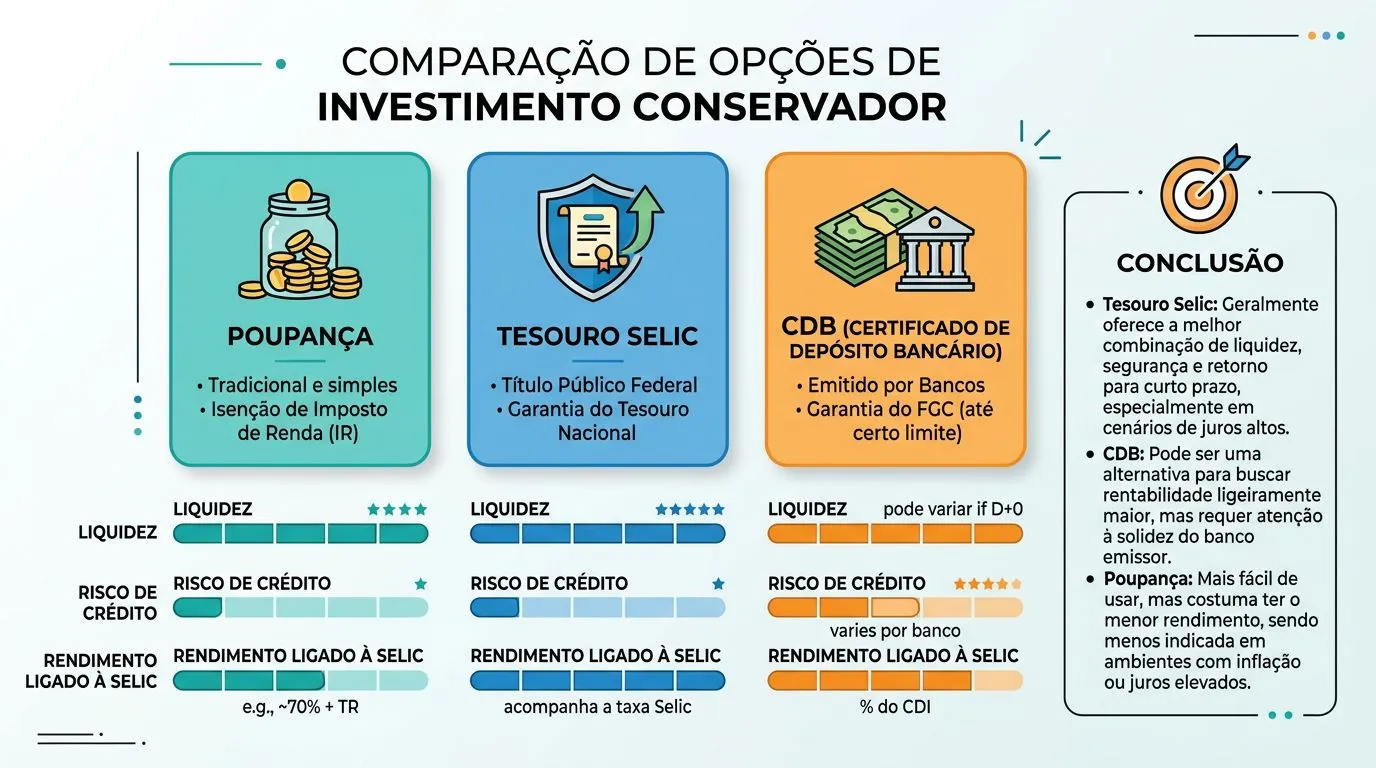
| Option | Liquidity | Credit risk | Return tied to the Selic rate | Best suited for |
|---|---|---|---|---|
| Savings account | High, with easy access | Low, but with historically lower returns | Does not directly track the Selic rate | People who prioritize convenience and already have the discipline not to touch the money |
| Tesouro Selic | Good liquidity and a focus on emergency savings | The lowest credit risk among the options compared because it is a government bond | Yes, it tracks 100% of the Selic rate, according to the Santa Catarina Judiciary | People who want emergency savings with a good balance of security and returns |
| CDB | Liquidity may vary depending on the security | It depends on the issuer and FGC protection | It may or may not track the Selic well | People willing to compare the term, issuer, and withdrawal rules before investing |
Here’s the deciding point: emergency savings aren’t meant to “chase returns.” They need to be available when something disrupts your plans. Keeping everything in a savings account is convenient, but it usually isn’t very efficient. According to the comparison by the Santa Catarina Judiciary, Tesouro Selic tracks 100% of the Selic rate and was designed for this purpose. A CDB, meanwhile, can be a better or worse fit depending on its term, liquidity, and issuer.
If you want a quick rule, choose an emergency fund you can access within a short time, one that preserves its value and doesn’t force an emotional decision whenever an unexpected expense appears. For most people, keeping it separate from everyday spending makes that easier and reduces the temptation to spend impulsively.
The simplest tricks that work in everyday life without changing your routine
Once the structure is set up, small changes can start adding up. They work by targeting spending you barely notice, not by turning your life into a constant hunt for something else to cut.
- Cancel subscriptions you have not opened in weeks, and keep only the ones you use regularly.
- Negotiate bank fees and account packages when your usage is lower than what the plan allows.
- Put payments on your credit card in one place only when you have complete control over the bill, so you do not mix spending with debt.
- Use due date alerts and automatic payments only for fixed bills, never for variable expenses that need to be reviewed.
- Review old installment purchases because small payments can keep taking up room in your personal budget for months.
- Put your monthly surplus toward your emergency fund before increasing spending in any other category.
Here’s one practical detail: money left at the end of the month often disappears when it sits in your checking account without a job. Set up an automatic transfer to your emergency fund right after payday, and you can close that leak. It’s not a magic trick. It simply removes some friction from saving money that was already available.
Digital banking apps can make this organization easier, provided you use them to support your budget rather than encourage more spending. PagBank and Mercado Pago, for example, offer platforms that let you review income and expenses and set money aside more easily. The benefit comes from consistently tracking your money, not from the app itself.
How to decide what to cut first without disrupting your routine
Start with expenses that recur, rarely get used, and are easy to cancel. That combination often saves money without making you resent your personal budget.
Next, look at costs that genuinely add up, including credit card interest and bank services you could replace with simpler options. If you’re choosing between buying less food and canceling an unused subscription, the answer is pretty clear.
Saving money without changing your lifestyle has less to do with deprivation than with the way your money moves. People who track spending, set money aside, and compare their options tend to make stronger decisions. Those decisions can help you save more without making the month feel like a sacrifice.
Frequently asked questions
How can I find out which recurring expenses are draining my budget?
Review your bank statements and credit card bills from the past two or three months. Flag every charge that repeats automatically. The clearest sign of a leak is often a small expense that started appearing without you noticing, such as a subscription, fee, or old installment payment. If it keeps coming out every month but no longer gives you real value, you’ve found a good place to start.
Is it worth cutting everything nonessential all at once?
Não. Os cortes mais sustentáveis são os que mantêm sua rotina principal e começam pelos pequenos vazamentos, como parcelas menores, tarifas e assinaturas esquecidas. Quando você tenta reduzir gastos em todas as áreas de uma vez, pode desmontar o orçamento e abandonar o plano pouco tempo depois.
When does it make sense to use your emergency fund to pay off debt?
Só vale a pena quando a dívida custa mais do que deixar o dinheiro parado, especialmente se envolver juros altos do cartão de crédito. Antes de usar sua reserva de emergência, confira se o acordo realmente reduz o custo total e se ainda sobrará dinheiro suficiente depois do pagamento. Se a renegociação apenas empurrar a dívida para mais adiante, ela perde o sentido.
Can a savings account serve as an emergency fund?
Pode, porque o dinheiro fica fácil de acessar, mas a poupança geralmente rende menos do que alternativas atreladas à taxa Selic. Em uma reserva de emergência, liquidez e segurança vêm primeiro, em vez da busca por retornos agressivos. Se a ideia é ter dinheiro disponível para despesas inesperadas, a poupança cumpre esse papel, mas pode ser menos eficiente do que o Tesouro Selic ou um CDB com condições de resgate adequadas.