
How to invest in real estate funds and receive monthly rental income
Real estate funds bring money from multiple investors together to buy properties or assets connected to the real estate market, following Law No. 8,668/1993 and CVM Resolution No. 175/2022, according to the Investor Portal of the CVMCVM. In many cases, monthly income comes from rent, interest, or other cash flows generated by the portfolio. The fund’s share price can still rise or fall on the stock exchange, though, so regular distributions don’t mean the market price will remain steady.
Key takeaways
- Monthly income from a real estate fund can come from rent, interest, or other portfolio cash flows, but the fund share can still fluctuate on the stock exchange.
- Vacancy, concentration, and contract length affect risk: an empty property or a financially weak tenant can affect the fund's cash flow.
- Before buying, review the fund's bylaws, management report, periodic disclosure, and material facts on Fundos.NET and the CVM website.
- Compare the share's market price with its net asset value to understand whether the discount or premium makes sense.
- Tax treatment and distribution rules must be confirmed in the fund's official documents and through the CVM's sources before buying.
What real estate funds are and where monthly income comes from
A real estate fund is a pooled investment structure that buys properties, property rights, or securities connected to the real estate sector. The CVM itself notes that “real estate ventures” is a broad category. It can cover both rights related to properties and securities tied to the real estate market. That’s where brick-and-mortar, receivables, and hybrid real estate funds fit, with each type relying on a different main source of returns.
In practice, monthly income might come from rent paid on warehouses, office buildings, shopping centers, bank branches, or other properties. It can also come from interest and adjustments on securities linked to the sector. That distinction matters because income predictability varies: a fund holding physical properties depends on occupancy and lease renewals, while a paper fund is more exposed to benchmarks, credit risk, and defaults on its securities.
A fund share can gain or lose value even when the fund makes regular income distributions. The monthly payment reflects earnings being distributed, while the market price responds to supply and demand, perceived risk, portfolio quality, and expectations about future cash flows.
That’s why two funds paying similar dividends can still behave very differently. If one has low vacancy and long-term leases, its income will usually be more predictable; if the other is concentrated in a few assets, has financially weak tenants, or relies on a single property, its distributions may swing more from month to month.
How to assess quality and risk before buying fund shares
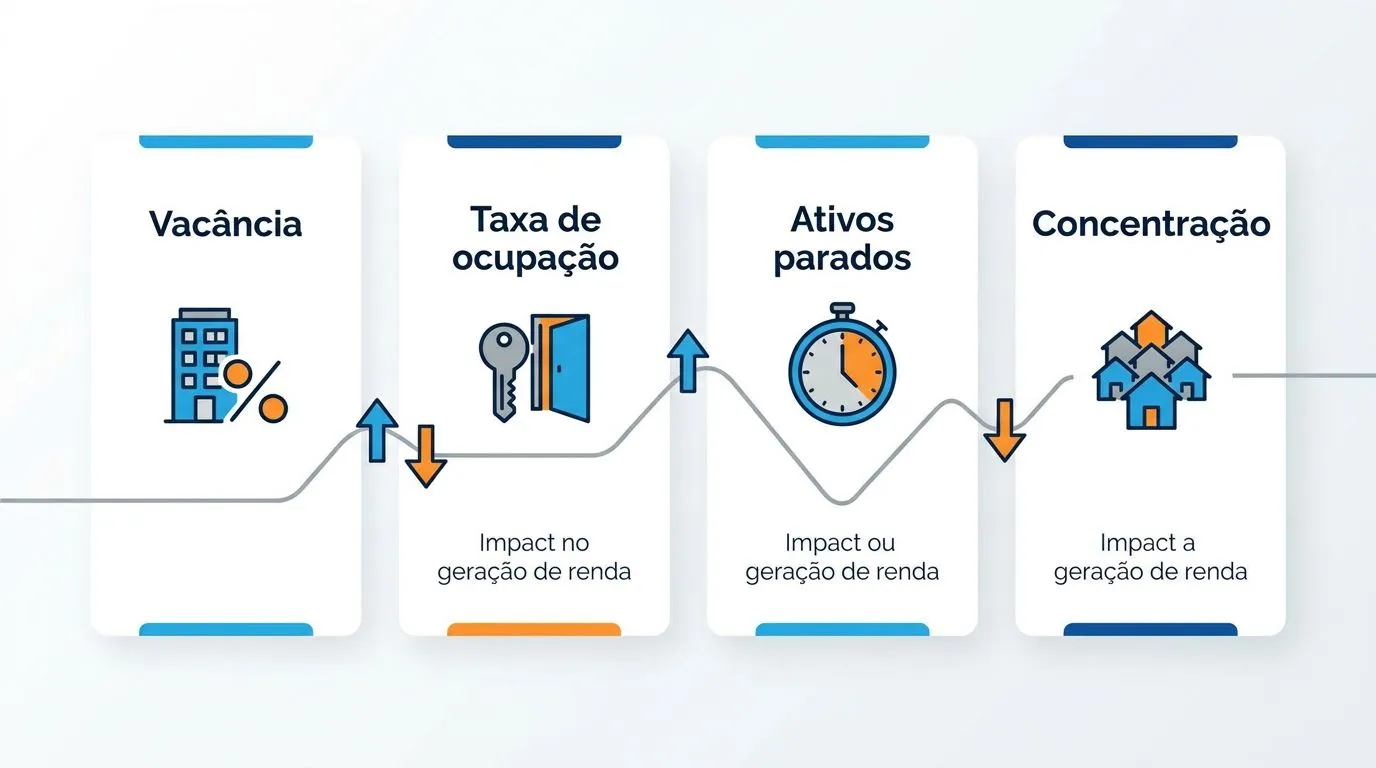
| Analysis criterion | What to look for | Warning sign | Where it appears in official documents |
|---|---|---|---|
| Vacancy | Occupancy rate, idle assets, and impact on income generation | Rising vacancy or excessive concentration in a small number of properties or tenants | Management reports and material disclosures |
| Lease quality | Lease term, contract type, and tenant profile | Short-term leases, renegotiation risk, or financially weak tenants | Fund management reports and presentations |
| Net asset value and market price | Difference between the share's net asset value and its trading price | Price far above or below net asset value without clear justification | Periodic filing, management report, and market data |
| Distribution history | Consistency of distributions and stability over time | Concentrated distributions over just a few months or recurring unexplained declines | Management reports and distribution history |
| Strategy and portfolio | Asset type, sector, region, and concentration level | Poorly diversified portfolio or a strategy that is difficult to understand | Fund bylaws, fact sheet, and reports |
The first thing to check is whether the fund can generate cash consistently. High or rising physical vacancy usually puts pressure on income because vacant space isn’t producing rent. A portfolio concentrated in only a few assets or tenants also makes any isolated problem more damaging.
Then review the leases, rather than focusing only on that month’s distribution. Short lease terms, repeated renegotiations, and tenants in weak financial condition generally add uncertainty, even if the fund looks inexpensive on the brokerage platform.
Comparing net asset value with the market price is useful too. When a share trades well above net asset value, you’re paying a premium that the asset quality and income-generating ability need to justify. When it trades well below net asset value, the discount may be real, or the market may already be pricing in a risk that the current distribution hasn’t shown yet.
How to review a fund's official information before buying
- Visit the fund's page on the Fundos.NET system and the CVM portal to locate the REIT's official documents.
- Read the bylaws and permitted offering materials to identify the fund class, investment policy, and portfolio limits.
- Open the management reports, periodic filings, meeting minutes, and material fact notices to review changes, risks, management decisions, and material events.
- If there is an offering, review the offering documents to understand the terms, registration, and formal fundraising information.
- Compare what appears on market platforms with the official documents, and use the official materials as your primary reference.
This review helps keep you from buying a fund based solely on someone else’s summary. The CVM maintains the Investor Portal with the product’s regulatory overview. The Fundos.NET system also gathers documents that can help you verify what the fund claims to do, what it has actually delivered, and what has changed over time.
The practical takeaway is straightforward: when a management report mentions vacancy, portfolio turnover, or lease revisions, read the full explanation in the official document instead of relying on a news headline. A material fact notice means something significant has happened, so read it carefully before buying.
Taxation of real estate funds for individual investors
For FIIs, tax treatment separates distributed income from capital gains earned when shares are sold. For individuals, distributions are generally treated favorably when the fund’s structure and the investor’s circumstances satisfy the applicable legal requirements. Even so, each case should be confirmed by reviewing the fund’s rules and the current guidance from Brazil’s Federal Revenue Service.
Gains from selling shares follow different rules. If you sell for a profit, that gain may be taxable. Investors need to determine how the rules apply to their own situation because the treatment can vary according to the shareholder’s profile and the type of transaction.
To avoid costly mistakes, check the latest guidance from Brazil’s Federal Revenue Service and the fund’s regulatory documents. Pay particular attention if you’re unsure about the investor profile, the offering, amortization, or a change to the fund’s structure. With taxes, assuming every FII distribution follows the same rules can become an expensive error.
Common beginner mistakes when choosing an FII
- Looking only at the month’s distribution and ignoring where that payment came from.
- Mistaking a high yield for a healthy fund without checking vacancy, payment defaults, and concentration.
- Failing to check lease terms, tenant quality, and the types of properties in the portfolio.
- Buying without reading management reports and material disclosures, and missing significant changes to the fund.
- Making a decision based only on share-price comparisons without considering net asset value, strategy, and risk.
The most common mistake is treating the latest dividend as a promise of what comes next. A larger payment may come from an asset sale, a nonrecurring event, or a temporary effect. There’s no guarantee that the same amount will show up the following month.
Another easy mistake is confusing a lower share price with lower risk. The market may be pricing in vacancy, concentration, short lease terms, or operational uncertainty. A fund can look cheap while still carrying serious risks.
Many investors also buy without reading the official documents. That choice can leave out the details that separate a solid FII from a troubled one, including material disclosures, management reports, leases, physical vacancy, gross leasable area, distribution history, and the fund’s long-term strategy.
How to turn your research into a buying decision
If you want to start investing in real estate funds, begin by understanding where the income comes from. Then assess the operational risk, and only after that examine the share price. Monthly income is possible, but it can change with vacancy, lease quality, concentration, and portfolio performance. A steady-looking figure on the screen may hide volatility in the fund or in its market price.
In practice, your own circumstances still shape three decisions. First, decide whether you want income linked more closely to physical properties or to real estate-related securities, since each choice brings a different type of risk. Second, consider whether you can handle larger share-price swings for greater return potential or would rather choose something more predictable. Before buying your first share, verify the details in the official documents, including Fundos.NET, the Brazilian Securities and Exchange Commission, the fund’s rules, and its material disclosures.
Frequently asked questions
How often do real estate funds pay distributions?
The payment schedule depends on each fund’s rules, although monthly distributions are the most common. Payments can change when the fund’s strategy, vacancy level, or portfolio performance changes. Check the management report and official disclosures to confirm when that fund actually pays.
Can I buy real estate funds with a small amount of money?
Yes. You buy shares, and the amount you need to start depends on the fund’s market price on the exchange, so the minimum investment can be relatively low. Your actual cost is the share price multiplied by the number of shares you purchase, plus any brokerage fee. That makes it possible to begin with a small amount and build the position over time.
Which document shows whether the fund has undergone a significant change?
Material facts are the best starting point when a fund goes through a significant change. These notices typically cover events such as vacancies, acquisitions, sales, or a strategy review. After that, compare the information with the periodic reports to see how the change affects income and the portfolio.
Does every real estate investment trust pay distributions every month?
No. Many REITs pay monthly, but that schedule isn’t universal. Each fund’s governing documents may set a different payment frequency. More importantly, a history of distributions is not the same as a fixed obligation, because income depends on the fund’s results and its distribution policy.