
Everything You Need to Know About Payroll-Deducted Loans: Benefits, Precautions, and Borrowing Limits
A payroll-deducted loan takes its payments straight from your paycheck or benefit. There are no payment slips and no co-signer. This option is generally available to INSS retirees and survivors, government employees, and employees of companies with a payroll-deduction agreement. This guide does not cover payroll-deducted credit cards or refinancing, because each has its own rules.
Key takeaways
- Taking out the loan requires an active source of eligible income, and INSS benefit verification can be completed within 5 days after the transaction.
- For federal government employees, the overall available borrowing margin is 40% through 01/13/2027, according to official rules from the Portal do Servidor.
- Before you sign, the contract must show the interest rate, total effective cost (CET), number of payments, payment amount, and total cost.
- A longer term lowers the monthly payment but tends to increase the total cost, so comparing payments alone can distort your decision.
What Is a Payroll-Deducted Loan, and Who Can Take One Out?
With a payroll-deducted loan, the payment comes out of your paycheck or benefit automatically. That lowers the institution's risk of late payments and makes collection simpler, since repayment is connected to your income source from the beginning.
A Caixa Econômica Federal describes this type of loan as one that does not require a co-signer. Payments come directly from a paycheck or benefit. That distinction matters: approval depends not only on your credit score, but also on whether you receive income that can support payroll deductions.
INSS retirees and survivors, government employees, and employees of private companies or agencies with a payroll-deduction agreement are the people who most often use these loans. When Social Security benefits are involved, the transaction is confirmed through Meu INSS, and the beneficiary has up to 5 days after taking out the loan to validate it.
In practical terms, this creates two different outcomes. The bank gets a more predictable loan. Consumers, meanwhile, need to check how stable their income is and how much borrowing margin remains, since those details determine whether the payment actually fits the budget.
How the Payroll-Deduction Limit Works and Where to Check It
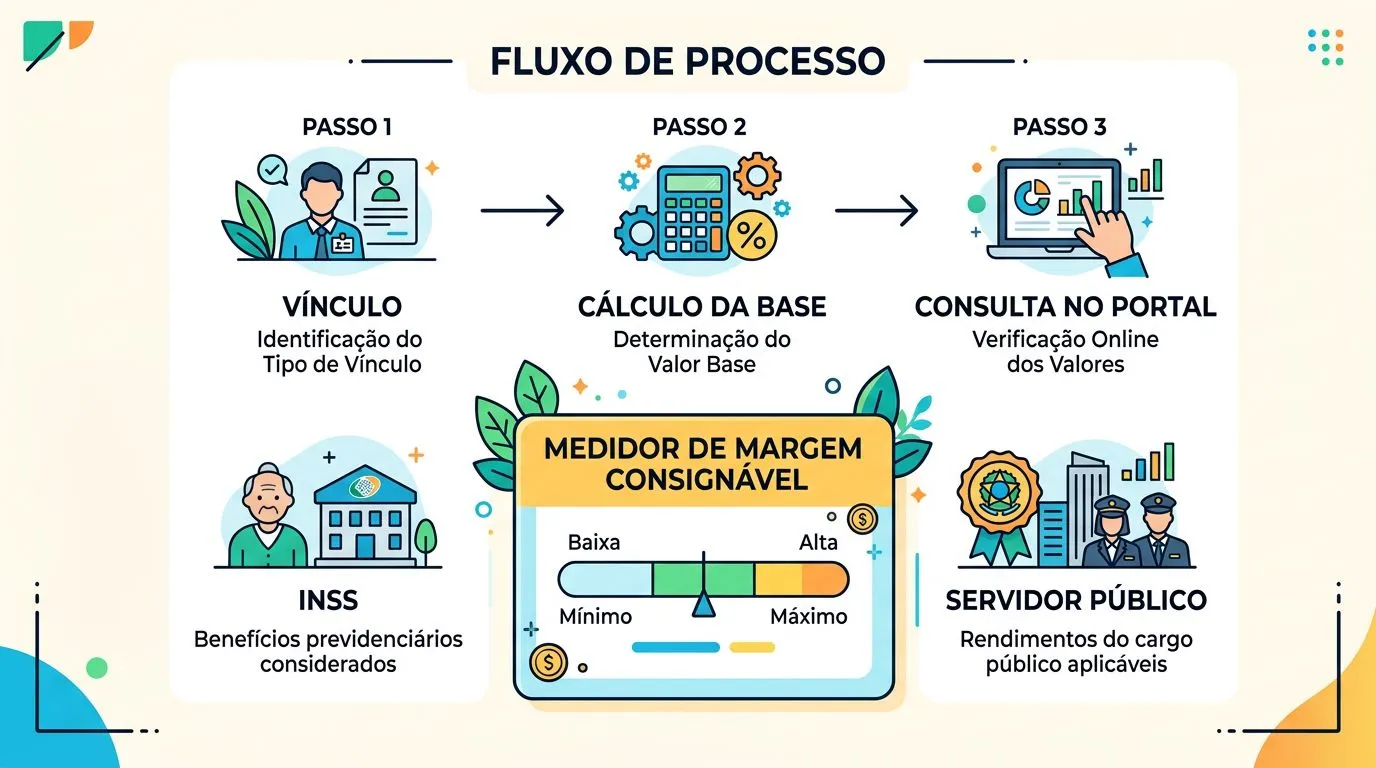
| Income source | Basis used for the calculation | Where to check | What changes in practice |
|---|---|---|---|
| INSS benefit | Benefit available for a payroll-deducted loan after the deductions covered by the rule | Meu INSS | The amount approved depends on the benefit and any other payroll-deducted loans already active |
| Federal public employee | Gross pay, subject to the applicable limits for optional payroll deductions | SouGov.br and the Portal do Servidor | The deduction limit follows compensation and may change with raises or new payroll-deducted loans |
| Employee covered by an agreement | Payroll from the employment relationship that allows payroll deductions | The employer's or agreement's system | The available margin depends on the pay stub and the items already being deducted |
The payroll-deduction margin is the largest share of income that can go toward optional payroll deductions. For federal public employees, the Portal do Servidor reports that, as of 05/19/2026, the total available limit is 40% through 01/13/2027, with the division set by the official rules. The takeaway is simple: the payment amount depends on the space available within that limit, not on whatever amount the borrower would prefer to pay.
The right source is the one that shows your existing contract and the payroll deductions already active through your employment relationship. For federal public employees, that means SouGov.br. For INSS beneficiaries, the amount is shown in Meu INSS. For private-sector employees, the employer or the agreement's system is usually the practical reference.
A common mistake is to calculate the margin from gross income alone and overlook deductions that are already using part of it. Someone may have enough nominal salary for another payroll-deducted loan, yet still be denied because no available margin is left.
What costs and terms the offer must disclose before you sign
A legitimate offer must clearly state the interest rate, total cost of credit (CET), number of installments, amount of each payment, and the contract's total cost. Without those details, you're left looking at the individual payment. That's often the most misleading number when comparing offers.
The CET is usually the most useful figure for comparison because it brings together interest, fees, and other charges in the final cost. An interest rate can look appealing while the contract still costs more because of its term, fees, or specific transaction conditions.
For federal public servants, the Public Servant Portal Reports dated 05/20/2026 state that the maximum term rose from 96 to 120 consecutive monthly installments under Decree No. 12,957/2026, which amended Decree No. 8,690/2016. That doesn't mean every bank will offer 120 installments. It means the regulatory framework now permits that maximum term for the affected category.
In practice, the math is straightforward: extending the term lowers the monthly payment, but it usually raises the total amount paid by the end. So when you review the contract, look at the CET and the total repayment amount, not only the payment that fits your budget today.
If you have operational questions, the Central Bank of Brazil is the main reference for general guidance on payroll-deducted loans and the credit market. When comparing offers, don't ask only, “How much will I pay each month?” Ask the more useful question: “How much will I pay in total, and how long will this debt stay with me?”
How contracting, loan portability, and payroll deductions work
- The estimate shows the amount, term, rate, and payment before you sign anything.
- Next, you submit your information and the institution reviews it to verify eligibility and available borrowing margin.
- If the application is approved, the loan is registered or authorized for payroll deduction, allowing the payment to be deducted through the payment system.
- The payment begins to be deducted from your paycheck or benefit during the next cycle specified in the contract.
- With portability, the debt moves from one institution to another, with a new rate, new term, and potentially cash back if an additional amount is approved.
Portability doesn't erase the original debt. It changes the creditor and may alter the cost or term, but the original balance remains until the new lender pays it off. That detail often gets lost when someone focuses only on the promise of a lower monthly payment.
For private-sector employees, the employer or benefits system helps process the deduction. For public employees, the process runs through the agency's payroll-deduction systems. In some newer work-related programs, the FGTS Digital plays an operational role because the employer manual sets the maturity and reporting rules for installments under the relevant program.
When transferring a loan, consumers should compare four things: the refinanced balance, the new interest rate, the remaining term, and any cash-out amount. If even one of these details isn't provided in writing, the offer isn't complete yet.
What happens in the event of delinquency, termination, or suspension of the employment relationship
If the deduction stops because the employment relationship changes or ends, the debt doesn't disappear. Only the collection method changes. Depending on the contract and the rules governing the relationship, payment may shift from payroll to a benefit, severance pay, or another arrangement.
Under the Programa Crédito do Trabalhador, the employer's operating manual says that installments aren't deducted from the 13th-month salary and instead follow the monthly FGTS payment schedule. That gives the collection process clear operational boundaries. The contract should explain what happens when those boundaries no longer apply.
The contract decides what happens next. Check it for the rules on overdue installments, renegotiation, collection after termination, and possible use of severance pay. Anyone who signs without reading this section could find out too late how the debt will be collected after the employment relationship ends.
A payroll-deducted loan generally makes more sense when your income is stable, you still have borrowing capacity available, and the total cost remains manageable through the end of the term. The risk is higher if you're about to change jobs, end a benefit, or add the loan to several existing payroll deductions. In those cases, slow down and review the terms carefully.
Before deciding, check three details: the borrowing capacity available through your employment or benefit relationship, the contract's CET, and the clause explaining collection after termination or a change in the paying source. Once you have those details, you can tell whether the offer is truly affordable or whether the payment only looks manageable at first.
Frequently asked questions
Can I confirm a payroll-deducted loan after taking it out?
Yes. If the loan is tied to an INSS benefit, confirmation is completed through Meu INSS within 5 days of taking out the loan. The loan proceeds only after that validation, so missing the deadline can delay the release of the funds.
Where can I see the exact amount of my available payroll-deduction margin?
You can find this information in the system connected to your specific employment or benefit relationship. That's where you'll see the income used in the calculation and any active payroll deductions. For an INSS benefit, check Meu INSS. Federal public employees should use SouGov.br or the Portal do Servidor. Private-sector employees should check the employer's or program administrator's channel.
Can I get a payroll-deducted loan without a cosigner?
Yes. Caixa describes a payroll-deducted loan as a loan that doesn't require a cosigner, with payments taken directly from a paycheck or benefit. The key issue is whether you have a qualifying income source for payroll deduction, not whether you can provide a guarantor.
What happens if I do not have available borrowing capacity?
The loan can't be completed under the payroll-deduction rules. If you've already used your full available capacity, your usual options are to pay off or reduce another payroll-deducted loan, wait for your employment or benefit record to be updated, or seek a different form of credit. The contract can't exceed the limit you've already committed.
Does loan portability automatically lower the payment?
No. Portability can change the lender and may improve the interest rate or term, but the monthly payment drops only if the new offer actually lowers the cost or extends the term for the remaining balance under the negotiated conditions. If the outstanding balance, rate, and term change very little, the payment may stay about the same.