
What Is a Credit Score and How to Improve Yours
A credit score doesn’t guarantee approval, and it isn’t a measure of income by itself. It estimates how you generally repay debts, using your payment history and the information lenders can access. The same person can see different scores from different companies because the scoring model, data source, and even the day the score is checked may vary. The useful takeaway is knowing what can improve your score and what lenders actually review.
Key takeaways
- A credit score is a risk rating, not an automatic approval, and it can vary by company, scoring model, and date of inquiry.
- Lenders review payment history, personal information, financial records, and positive credit data, not just income.
- Late payments, excessive credit usage, and accumulated balances can hurt your score, while on-time payments and up-to-date information can help.
- Improvements do not appear everywhere on the same day because each source updates at its own pace, and each scoring model responds differently.
- A credit score, payment history, and estimated probability are not the same thing. The final decision still depends on the lender's policies.
What Is a Credit Score and What Does It Really Measure?
A credit score is a risk rating, not an approval stamp. According to the Consumer Financial Protection Bureau, it predicts credit behavior, including the likelihood that you’ll repay a loan on time, using information from your credit reports.
This matters because lenders, credit card companies, financing providers, landlords, and even insurers may consider your score when making decisions, as summarized by USAGov. In practice, the point is straightforward: a high score can make the process easier, but it doesn’t replace income, repayment ability, documentation, or the lender’s own policies.
There isn’t one universal credit score. The CFPB explains that the number can change depending on the data used, the scoring model, the type of product being reviewed, and even the day the score was calculated.
That distinction helps you avoid a common mistake: comparing the score in an app with a bank’s final decision as though they were identical. One is an estimate. The other is an approval decision that also reviews available credit limit, debt-to-income ratio, the length of your relationship with the institution, and its own lending criteria.
What Data Feeds Credit Analysis in Brazil
In Brazil, credit analysis generally brings together payment history, personal information, records of financial activity, and, when available, Cadastro Positivo. The table below outlines what each part contributes and what that information typically tells the lender.
| Data source or data process | What type of information is included | What this signals for the analysis | Practical example of use in Brazil | Limit of the assessment or point to consider |
|---|---|---|---|---|
| Credit reports and bureaus, such as Serasa Experian, Equifax, Experian, and TransUnion | Open accounts, late payments, defaults, credit inquiries, and financial relationships | Shows payment patterns and the presence of negative or consistent events | Approval of credit cards, personal loans, and financing | There may be differences between bureaus and the databases they consult |
| Cadastro Positivo (Positive Credit Registry) | On-time payments, active contracts, and behavior over time | Helps show consistency, not just late payments | Provides a clearer picture of people who pay bills and installments on time | Does not erase a poor history, it only adds context |
| Central Bank of Brazil Document 3050 | Credit approvals, interest rates, and terms reported by financial institutions | Makes it possible to track the structure of credit transactions in the system | Aggregated view of the market and regulatory monitoring | This is not an individual score; it is an aggregated statistical baseline |
| Consumer registration information and updates | Name, CPF number, address, phone number, reported income, and employment relationship | Reduces identification noise and improves the quality of the inquiry | Updating your information with a bank, fintech, or retailer | Outdated information can hinder the assessment even when there are no missed payments |
The key point is that credit analysis does not rely on one source alone. The Banco Central do Brasil, in its special study examining how closely the contractual IRR calculation matches Brazil’s aggregated National Financial System credit portfolio, explains that the analysis uses aggregated loan, rate, and term data reported by financial institutions. Credit bureaus and Cadastro Positivo then help shape the consumer’s profile.
What raises or lowers your score and how long it usually takes to show up
Your score tends to improve as your payment behavior becomes more consistent and predictable. Late payments, excessive debt, and signs of financial disorganization can pull it down. There’s no fixed timeline for the change to appear because each source updates on its own schedule, and scoring models weigh the information differently.
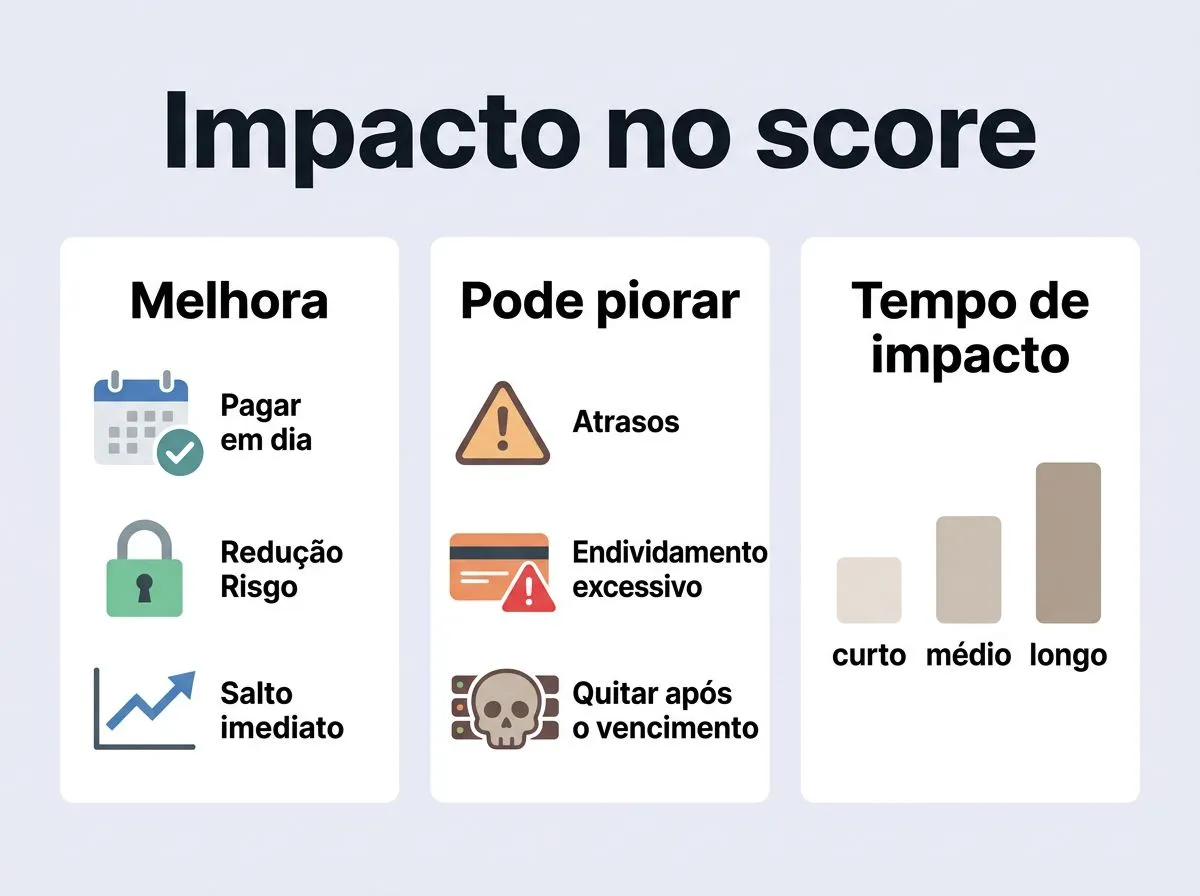
- Paying on time helps. Repeated late payments hurt. Paying a bill after its due date already prevents greater damage, but it does not have the same effect as paying on time from the start. If cash flow is tight, prioritize bills whose late payment is likely to result in a bureau record, higher collection costs, or service shutoff.
- Using credit sparingly helps. Maxed-out cards, frequent use of a high-interest revolving balance, and many open installment plans suggest financial pressure. Creditors read this as a risk that too much of your income is already committed, so the safest path is usually to reduce your balances and avoid new debt until you reorganize your budget.
- Keeping Cadastro Positivo and your personal information up to date helps show consistency. A name, address, phone number, and income that match your actual circumstances reduce noise in the assessment. People with stable income and a record of on-time payments generally benefit more from this track than those who only show negative records.
- The effect on your score depends on the source and the model. New information may appear quickly at one bureau, but the score does not necessarily change at the same time. To find out what is holding back your improvement, review the bureau’s report, check for late payments, recent new accounts, or outdated personal information, and correct the issue at its source first.
A common mistake is expecting an old debt payoff to create an instant jump. Paying it off helps, sometimes substantially, but the improvement usually develops alongside months of steady behavior, especially when the rest of the file still shows high credit utilization or too many recent inquiries.
Credit score, payment history, and estimated probability: what is the difference
The score is the number. Payment history is the raw material, and estimated probability is the risk assessment. Put simply, a score condenses your past into a number designed to help predict future behavior. It still doesn’t capture your entire financial history or, by itself, reveal the creditor’s full decision.
The distinction may look minor, but it changes how you should read the result. Someone can have a decent credit score and still be denied because of insufficient income, high monthly obligations, job instability, or missing documentation. The reverse can happen, too: a fair score may qualify for a more conservative credit line when the rest of the profile is strong.
That’s why a credit score can’t replace a complete review. Think of it as a filter, not the final verdict. The lender uses the score to estimate risk and set the limit, interest rate, and terms, then compares it with internal policy, the requested product, and the customer’s overall profile.
In practice, reading your score correctly means looking past the number itself. If your application was denied, check your credit report, debt level, and the stability of your information for clues about why. If you were approved with a low limit or a high interest rate, your score helped, but it didn’t do enough to ease all of the lender’s concerns about risk.
If you’re getting ready to apply for a credit card, loan, or financing, keep the strategy simple: stop missing payments, use less of your revolving credit, keep your information current, and check your credit report regularly. From there, improvement comes from building several months of positive activity. There’s no quick trick that replaces that track record.
Frequently asked questions
How long does it take for a credit score to change after a payment?
Your score can change soon after new information reaches the database, but there isn’t one timeline that applies to every case. The article explains that the timing depends on when the institution reports the information and which scoring model the credit bureau uses. Sometimes the update happens quickly. In other cases, the score responds only after a stretch of consistent behavior.
Does checking your credit score frequently lower it?
Not every inquiry affects your score in the same way, and checking your own score doesn’t automatically mean a drop. The effect depends on the type of inquiry listed on your credit report and how the scoring model interprets it. The key distinction is between monitoring inquiries, which are usually neutral, and inquiries made as part of a credit review.
Does having an old account help your credit score?
It can, particularly when the older account shows steady use and on-time payments. Account age alone won’t work miracles, but it can add to the lender’s sense of stability when the payment history is strong. An old account with late payments, heavy use, or outdated information won’t provide the same benefit.
Does a high credit score guarantee credit approval?
No. A high score strengthens your application, but the lender still looks at your income, monthly obligations, documentation, internal policy, and the product you’re requesting. As the article points out, even a reasonable score can lead to a denial. A fair score may still be approved when the rest of your financial profile is strong.