
Personal Loan: When It Makes Sense and How to Get the Best Rates
A personal loan is unsecured credit, and you can use the money for almost anything. Once the funds reach your account, the decision is yours. It can be a sensible choice when it solves a real problem at a lower total cost than the alternative. It stops making sense when it simply prolongs discretionary spending or patches over a payment you never properly planned.
Key takeaways
- The April 2026 average cited by Procon-SP was 8.44% per month, but the rate that matters is the offer based on your credit profile.
- A longer term lowers the payment, but increases the total amount paid, so the decision depends on your cash flow.
- The CET is the figure that shows the loan's true cost because it includes interest, IOF, fees, and other applicable charges.
- Comparing only the nominal rate is a common mistake; the right comparison is CET against CET, using the same loan amount and term.
- If the payment does not fit comfortably into your budget, the loan is more likely to become a problem than a solution.
This guide focuses on standard personal loans, not payroll-deducted loans or secured credit. The useful question isn’t “which bank advertises the lowest rate?” It’s “how much will I pay in totalover what term, and how much room will the payment leave in my budget?”
What Makes a Personal Loan More or Less Worthwhile
A personal loan may be worthwhile when it covers an urgent, predictable expense that costs less than the other options available to you. Medical care, an essential repair, or paying off more expensive debt can all qualify. The payment still needs to fit comfortably into your budget.
The advertised rate doesn’t tell you much on its own. In its April 2026 survey, Procon-SP reported an average monthly rate of 8.44% for personal loans from the banks it surveyed. Your key number, though, is the rate you’re actually offered based on your credit profile, and especially the total cost over the full life of the loan.
A longer term reduces the monthly payment, but it usually raises the total amount you’ll pay. That can relieve pressure on your cash flow, which matters when your budget is tight. The problem starts when the debt outlasts the useful life of what you financed, such as turning a short-term emergency purchase into payments that drag on for years.
In practice, the decision comes down to urgency, how you’ll use the money, and whether you can repay it. No clear purpose for the funds? The answer is probably no. If the expense prevents a larger loss or replaces more expensive credit, look at the total cost instead of being won over by a low monthly payment.
CET for Personal Loans: What Goes Into the True Cost
CET, or Total Effective Cost, is the number that brings together the full price of a credit transaction. It makes offers easier to compare because it includes the charges that actually appear in the contract, rather than only the interest rate advertised.
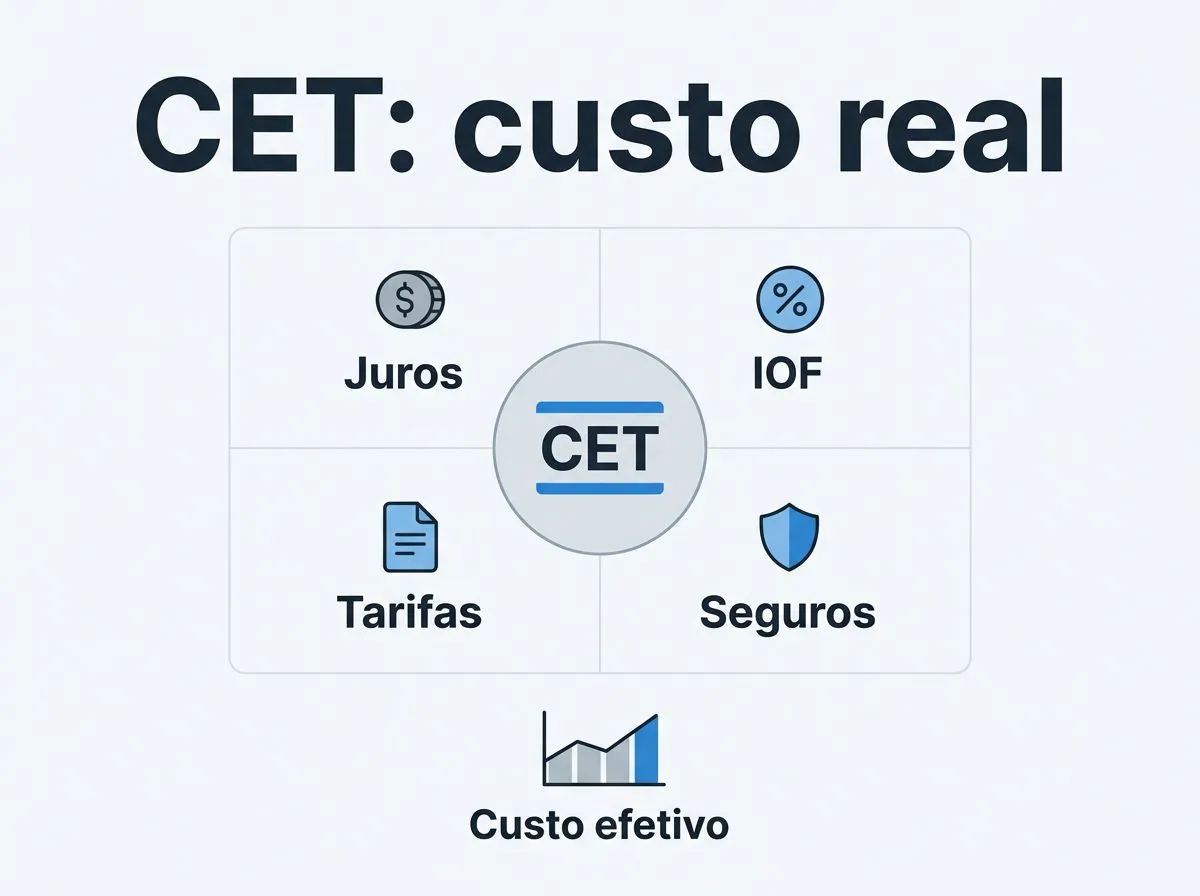
In practice, CET may include interest, IOF, administrative fees, and required insurance when those costs are part of the offer. CMN Resolution No. 3,517/2007 sets the regulatory basis for this disclosure, and the Central Bank of Brazil requires consumers to see the cost before they finalize the agreement.
The difference between the nominal interest rate and CET is straightforward: the nominal rate covers only the interest on the principal, while CET reflects what the debt actually costs. A loan with a lower advertised rate can still cost more once fees, bundled insurance, or a higher account setup fee are added.
Here’s the practical rule: compare CET with CET, using the same date, loan amount, and term. Looking only at the interest rate is a classic mistake. You end up comparing the advertisement instead of the loan you’ll actually repay.
Interest rate, term, and payment: how this calculation changes the final cost
| Monthly interest rate | Loan term | Payment amount | Estimated total paid | Impact on the final cost |
|---|---|---|---|---|
| 6.72% | 12 months | higher payment | lower total | final cost tends to be lower |
| 8.44% | 12 months | mid-range payment | mid-range total | reflects Procon-SP’s April 2026 average |
| 9.99% | 12 months | higher payment | higher total cost | the cost rises quickly as the term gets longer |
| 8.44% | 24 months | lower payment | higher total cost than with 12 months | monthly relief, but a longer debt |
The figures above use Procon-SP’s 8.44% monthly average from April 2026 as a market reference, not as a promise of what you’ll receive. Your offer could be higher or lower. The table illustrates the basic effect of the term: extending the contract lowers the payment, but raises the total cost because interest keeps accumulating for longer.
This is where borrowers often get tripped up. A smaller payment can feel safer, yet the final cost may climb sharply when the term doubles. If your income is tight, extending the term slightly may be reasonable, provided you accept the higher total cost and feel confident you won’t have to renegotiate later.
How to Compare Personal Loan Offers Before Signing
- Check the interest rate and CET using the same loan term. If one bank quotes 12 months and another quotes 24, the comparison is misleading. Adjust the analysis so the payments and terms are equivalent.
- Confirm whether IOF and other fees are included. If the proposal mentions an extra cost outside the CET, the contract’s actual cost increases and the offer is no longer comparable.
- Read the term, the number of payments, and the payment terms. A payment you can afford today may become a problem if it is due before your paycheck arrives.
- Check whether there is a grace period, required insurance, or an additional charge. Any included item changes the cost and must appear in writing before you sign.
Large banks such as Bradesco, Banco do Brasil, Caixa Econômica Federal, Itaú, and Santander generally offer different rates, both from one another and across customer profiles. Compare the actual offers you receive. Random tables found online won’t tell you what your loan will really cost.
What the Contract Must Include and How the Application Works
The contract should state the amount disbursed, interest rate, CET, term, number of payments, and amount of each payment. If one of those details is missing, you don’t have the full picture. The central question is simple: how much will this debt cost from the first payment to the last?
The document should also spell out fees, insurance, and any other charges. If the offer mentions digital or in-person enrollment, treat that as a review step, not a reason to click quickly. Check the final document before you accept anything.
The confirmation button isn’t more important than the draft agreement. Read the estimate, download the contract, and confirm that the numbers match the offer you were promised. If the CET appears only afterward, or insurance shows up as optional without a clear explanation, request a correction before moving forward.
What the contract must include and how the application process works
- Missing a payment increases the debt through default charges, and the cost starts growing beyond what was agreed.
- Renegotiating can extend the term and increase the total amount paid, even when the monthly payment goes down.
- Fees and insurance that were already included in the contract still make up part of the effective cost and do not simply disappear in practice.
- When a payment is late, compounding interest can make the debt spiral out of control faster than most people realize.
If the payment is already at its limit, the bigger risk isn't simply paying more. It's falling behind. From there, credit stops helping and starts becoming a burden. Renegotiation may seem like a way out, but it often just moves the problem further down the road.
Verification checklist before taking out the loan
- The estimate shows the CET, interest rate, term, and total amount to be paid in the same document.
- The contract explicitly lists IOF, fees, and required insurance, with no hidden fields.
- The payment fits comfortably within the budget, even if there is a month with extra expenses.
- The offer was compared with another offer for the same amount and term, not with isolated figures and different terms.
If all four points check out, the analysis was solid enough to support a decision with less risk. If even one falls short, ask for a new estimate or walk away from the deal. A personal loan is worthwhile only when the total cost fits your cash flow.
Frequently asked questions
Can I pay off a Personal Loan before the end of the term?
Generally, yes. Paying early usually reduces the interest that would otherwise accrue. With a Personal Loan, though, check whether the contract explains how the outstanding balance will be recalculated and whether charges that haven't come due will be reduced proportionally. If the rule isn't clear, request a payoff quote before sending the payment.
Can the CET change after the loan is taken out?
After you sign, the CET for the loan you took out shouldn't change unilaterally. The total cost can change if you pay late, renegotiate, or add new services connected to the debt. At that point, you're no longer dealing with the original contract. That's why the key comparison figure is the CET shown in the offer before you sign.
Do unsecured personal loans usually have higher interest rates?
Usually, yes, because the bank takes on more risk than it would with a secured loan. That makes comparing the APR especially important. Don't stop at the advertised rate, either. Check the loan term and monthly payment, since an offer with a lower advertised rate can still cost more after extra fees are added.
Is it worth taking out a loan to pay off another debt?
It makes sense only when the new debt has a lower total cost and the payment fits comfortably within your budget. In the guide, this strategy works when the loan replaces more expensive credit or helps prevent a larger financial loss. It doesn't work when it merely pushes the problem down the road. Stretch the term too far, and the total amount you pay may rise substantially.