
Home Equity or Vehicle-Secured Loan: Is It Worth Using One to Pay Off Debt?
If debt is already squeezing your budget and taking up most of your credit card limit or overdraft, a home equity loan or vehicle-secured loan could help replace high interest with a lower payment and a longer repayment period. It only makes sense if the new loan’s total effective cost, or CET, actually lowers the total amount you’ll pay, not just the monthly payment. You also need to afford it without putting your property or vehicle at risk because of a poorly planned move.
Key takeaways
- The loan only makes sense if the new CET reduces the total cost of the debt, not just the payment.
- A home equity loan usually provides larger amounts and longer terms, while vehicle-secured loans tend to have shorter contracts.
- The LTV determines how much of the property's or vehicle's value is included in the loan and helps predict the rate, amount and level of risk the bank will accept.
- Even with collateral, income and payment history remain part of the review and may limit approval.
- A prolonged payment default can lead to repossession of the property or vehicle, so the payment needs to fit comfortably within your budget.
This guide focuses on home equity loans and vehicle-secured loans. Unsecured personal loans aren’t included because their approval rules, interest rates, and risks are different.
What Is a Secured Loan, and When Does It Make Sense for Paying Off Debt?
With this type of loan, a property or vehicle backs the debt, usually through a fiduciary lien. That collateral lowers the lender’s risk, which can create room for lower rates and longer terms. The trade-off works only when the existing debt costs more than the new loan and the money goes toward paying off expensive liabilities instead of funding new spending.
This option often works best for borrowers who want to roll credit card balances, overdrafts, or revolving loans into one more predictable payment. It may also help when most of your income is already committed and the real issue is cash flow. Be careful with the math, though: extending the term can lower the monthly payment while increasing the total amount you pay.
Caixa says a home equity loan can be used to pay off an existing mortgage or loan, with the option to borrow additional funds. You may also keep the current financing in place and use the same property as collateral for a second loan. In either case, the transaction depends on the equity available in the property and your ability to repay the debt.
Property or Vehicle: Which Type of Collateral Usually Provides More Funding, and Why?
| Criteria | Property | Vehicle |
|---|---|---|
| Typical percentage financed | Generally higher, with market materials showing offers of up to 60% of the property's value, and up to 60% at Creditas | Generally lower in more conservative transactions, although Banco BV cites up to 120% in its offer and Serasa Crédito shows simulations of up to 90% of the car's value |
| Term | Typically longer, which lowers the monthly payment | Usually shorter, with terms of up to 60 months at Banco BV and terms that vary by lender |
| Typical cost | Generally lower because the collateral offers greater security and liquidity | It can be competitive, but the final price depends more on the customer’s profile, the vehicle’s condition, and the lender’s policy |
| Use of the collateral | The borrower continues to use the property during the term of the agreement, but it remains tied to the loan | The vehicle remains in normal use, subject to contractual restrictions and documentation and inspection requirements |
| Appraisal and documentation | Requires a property appraisal and an assessment of the title records, income, and ability to repay | Requires a vehicle appraisal, inspection, up-to-date documentation, and verification of ownership or a lien accepted by the bank |
The practical takeaway is simple: a property-backed loan usually supports larger amounts and longer terms, which can help when you’re renegotiating substantial debt. A vehicle-backed loan is often faster to arrange and may be a better fit for a smaller borrowing need. At BV, for example, the offer mentions terms of up to 72 months, while Serasa Crédito highlights longer terms depending on the partner.
What determines the rate, term, and amount released under the agreement
Start with LTV, or loan-to-value. It measures the loan amount against the value of the collateral accepted in the appraisal. A lower LTV gives the lender more room to absorb a loss and will generally produce a better offer for the borrower, since the collateral covers more of the debt being taken on.
The property or vehicle appraisal is more than a box to check. It sets the value the lender uses to determine how much it can lend. That accepted value may come in below the owner’s expectations, especially if the asset would be difficult to sell, has been poorly maintained, or has incomplete documentation.
Credit analysis comes next. Collateral helps, but your income, payment history, and existing monthly debt still count. The lender needs to see that the payment fits your budget before accepting the asset as security.
The loan’s real cost shows up in the APR, or total effective cost, which includes interest, IOF tax, fees, and any insurance. That figure lets you compare offers from different banks without getting distracted by a low advertised monthly rate. Put each offer’s total APR and final amount paid side by side before you choose.
What are the risks and costs of using an asset as collateral?
- With a fiduciary lien, the asset remains tied to the lender until the loan is paid off. The customer can continue using the property or vehicle, but cannot treat the asset as if it were free of liens.
- If there is a prolonged delay and default, the lender may take steps to repossess and sell the asset, because the collateral exists specifically to cover nonpayment.
- Common costs include the asset appraisal, an account setup fee, IOF tax, and, in some contracts, insurance tied to the loan.
- The CET, or total effective cost, is the key figure. Without it, comparing offers can be misleading because the payment may look smaller while the total cost increases.
- Financial risk is not the same as the risk to your assets. Someone who looks only at the payment may forget that they are putting a significant asset on the line.
The practical consequence is serious: this kind of credit only works when the payment fits comfortably within your budget and the restructuring clearly replaces more expensive debt. If the numbers are already tight, the asset becomes a temporary crutch for a cash flow problem that remains unresolved.
How to decide whether it is worth using to pay off debt without losing liquidity
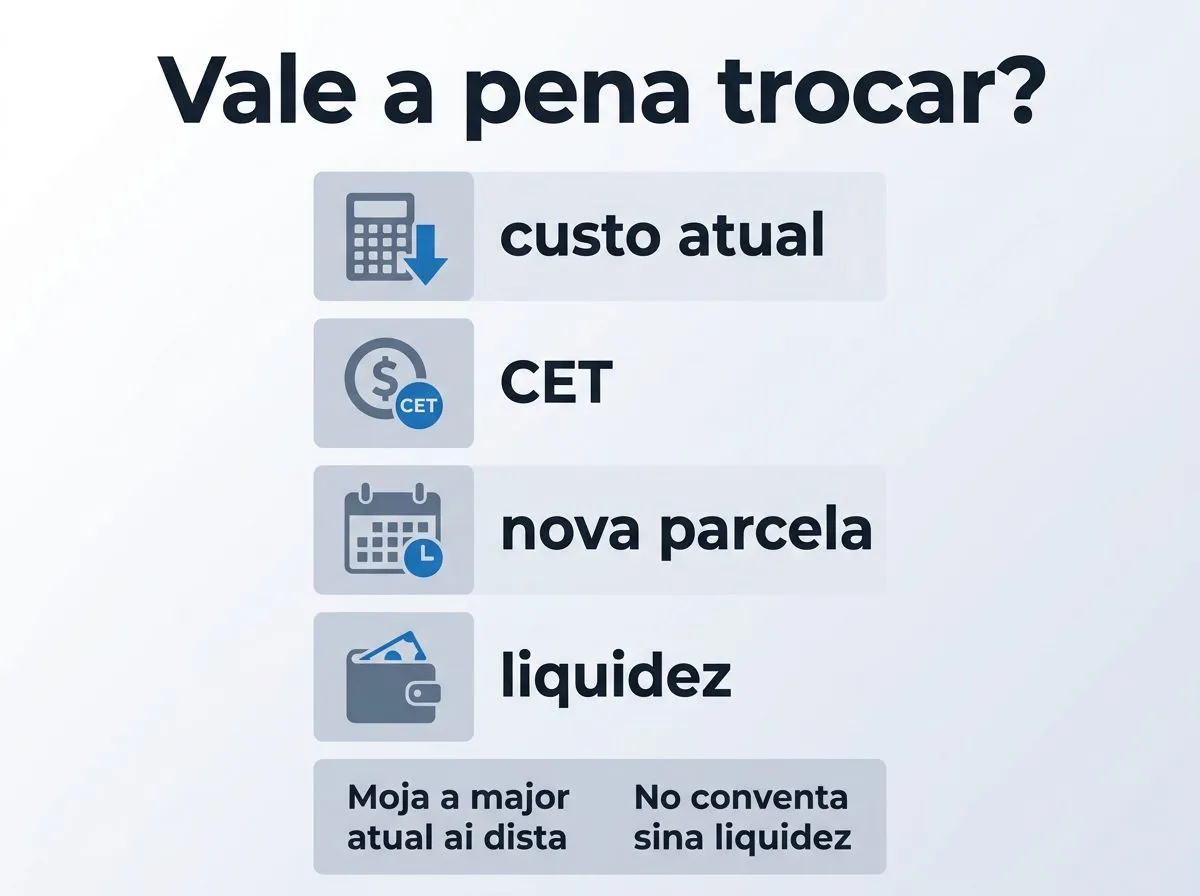
- Compare the CET of the collateral-backed loan with the cost of the debts you want to pay off. If the new total cost is lower than what you pay today, switching starts to make sense.
- Check whether the new payment actually eases your monthly pressure without extending the term so much that it makes the final total far more expensive.
- Separate emergencies from debt restructuring. Using an asset as collateral for new spending or to cover a shortfall without an exit plan usually makes the situation worse.
- Calculate the net amount left after paying off your current debts and covering every loan cost, including IOF tax, the appraisal fee, and other charges in the contract.
- Move forward only if your budget remains comfortable after the switch and you accept the risk of losing the property or vehicle if you fall behind again.
A sound decision should improve two things at the same time: the cost of the debt and your monthly cash flow. If the loan only lowers the payment by stretching the term too far, or turns an expensive debt problem into a risk to your asset, it has stopped solving the problem. It’s simply pushing the pressure further into the future.
For a simulation, compare the terms offered by Caixa, Serasa Crédito, Creditas, and Banco BV. Each lender may use different LTV ranges, loan terms, and documentation requirements. Don’t choose based on the most attractive advertisement. Check the CET, the net amount you’ll receive, and whether you can keep making the payments without putting your finances under strain.
If your current debt is out of control and the property or vehicle is a genuine asset that can support the loan without damaging your financial stability, this type of borrowing may help. But if the plan relies on an extremely long term just to create breathing room, the loan may postpone the crisis without fixing it. You would still face the risk of repossession and sale of the asset after a default.
Frequently asked questions
Can I take out a collateral-backed loan if the property is still being financed?
You may be able to do so with some lenders, provided the property still has enough available equity and the loan meets the lender’s internal requirements. The text explains that some banks allow the same property to secure a new loan while the original mortgage remains active. Approval depends on reviewing the balance already tied to the property and your ability to repay.
Who needs to sign when the asset is not owned by the person taking out the loan?
The owner generally needs to sign the agreement and participate in the transaction because they’re pledging the asset as collateral. In many cases, the lender also requires the owner’s income to be included in the application, even when that person isn’t the primary borrower. Without this formal step, the lender is unlikely to accept the property or vehicle as security.
Does the money have to be used to pay off debts?
No. After the loan is approved and the funds are released, you can use the money as you choose. Even so, this article explains that the loan usually makes the most sense when it replaces more expensive debt, such as credit card balances or overdraft lines, with payments that are more predictable and a lower total cost.
How long does it take to release the funds?
It comes down to the credit review, the asset appraisal, and recording the lien. With those extra steps in the process, funding usually takes longer than it does with a standard personal loan. In practice, the timeline can vary a lot based on the lender and how complete the borrower’s documentation is.
Could I lose the asset if I fall behind on payments?
Yes. If you stay delinquent for an extended period and don’t bring the debt current, the lender may enforce its security interest under the loan agreement and applicable law. That’s the key risk with this type of loan: your property could be at stake, so the payment should fit comfortably within your budget from the beginning.