
How to Renegotiate Debt and Clear Your Record with Banks and Finance Companies
If a bank or finance company reported your CPF as delinquent, you generally need to handle two things: negotiate the debt with the creditor, then demand that the negative credit entry be removed after payment or if it was reported by mistake. This guide deals only with negative entries in credit reporting databases involving bank and finance company debt. It does not cover court protests, employment-related debt, or taxes.
Key takeaways
- The negative entry must be removed within five business days after full payment, according to STJ Precedent 548.
- If the payment posts on a weekend or holiday, the deadline starts on the next business day after the funds become available.
- The agreement should state the balance, discount, installments, due dates, and the exact trigger for removing the CPF entry.
- Payment does not end collection efforts by itself. Without proof of the agreement and payment receipts, it becomes harder to demand removal of the entry.
- If the negative entry is incorrect, request the contract and collection documents before accepting any offer.
What a Negative Credit Entry Is and How It Works in Practice
A negative credit entry appears when a creditor adds your CPF to a delinquent borrower database after a debt becomes overdue, payment is missed, and the creditor chooses to report the default to the market. The debt comes first. Delinquency starts with the missed payment. The negative entry is what makes the problem visible during credit decisions.
In practice, banks and finance companies often warn consumers before or around the time they report the debt. The notice may arrive by letter, email, text message, or an in-app alert, followed by the submission to credit bureaus. The effect usually becomes clear when someone applies for a credit card, loan, installment plan, or financing. Underwriting gets tighter, credit limits often fall, and approval may be denied.
The entry doesn’t erase the debt or create a new collection claim. It signals risk to the market, and that usually changes how the consumer deals with the institution. Rather than applying for new credit, the focus shifts to negotiating a payoff, discount, down payment, or installment plan, while making sure the agreement explains when the negative entry will be removed.
This article focuses on debt owed to banks and finance companies. A court protest or a dispute involving an employer, the tax authority, or the Treasury follows different rules, so those cases need to be handled through another process.
Which Rules and Deadlines Apply to Reporting and Removing Your Name
The creditor must notify the consumer in advance and, after payment, remove the name from the database within a short period. The practical legal basis includes STJ Precedent 404, which waives the need to prove that the notice letter was received, and STJ Precedent 548, which requires removal within five business days after full payment.
The deadline begins on the next business day after the funds become available to the creditor, as explained by STJ Repetitive Theme 735 and applied by the Court of Justice of the Federal District and Territories. That distinction matters. A payment made on a weekend or holiday doesn’t start the count on the receipt date. The clock begins on the next business day, once the creditor can access the money.
If the agreement uses installments and the creditor promises to remove the name after the first payment, that agreed condition controls the timing. Still, the general rule consumers should look for is removal within five business days after the debt is fully paid, unless the agreement clearly and validly sets another trigger.
A common mistake is thinking that paying the bill automatically takes care of the rest. Payment settles the debt, but removing the negative entry still depends on the creditor meeting the deadline. Keep the payment receipt. If the record remains, that document is your starting point for demanding the update.
How to Renegotiate Debt with a Bank or Finance Company and What the Agreement Must Include
1. Contact the bank or finance company that reported the debt directly. Use the official channels listed by the institution, rather than an unverified contact. Brazil’s Ministry of Finance advises consumers to contact the institution where they owe the money, and the Central Bank of Brazil offers general guidance on renegotiating and paying debts within the financial system.
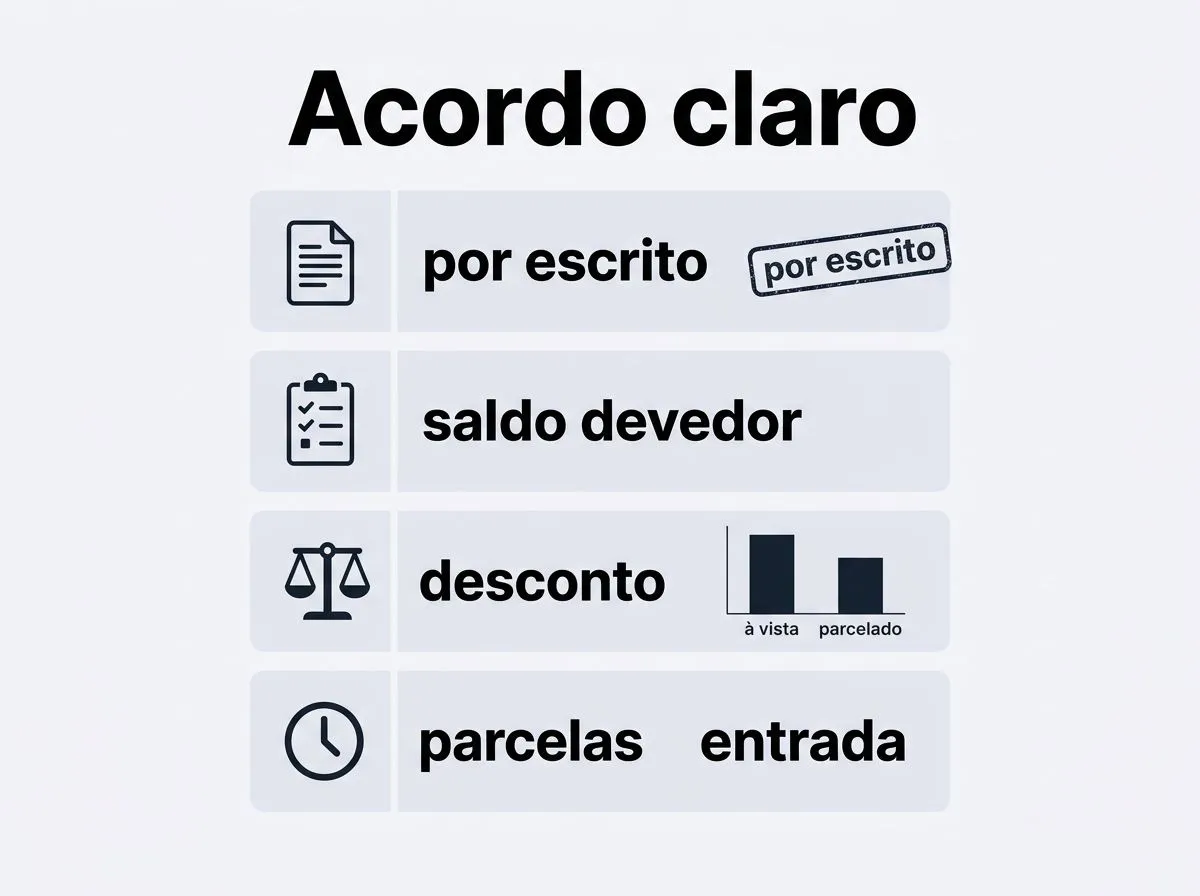
2. Ask for the offer in writing, then review the total before you accept it. The agreement should spell out the outstanding balance, discount, down payment, number of installments, amount of each payment, fees, due date, and consequences of falling behind again. If one of these points is unclear, ask for clarification before paying.
3. Compare full payment with an installment plan, including what each option means for your credit record. Paying in full will generally settle the debt and lead to faster removal of the negative entry, provided the account is updated correctly. With installments, confirm whether removal happens after the first payment or only after the final one. That detail can change the practical value of the deal.
4. Save every record. Keep the offer, payment slips, receipts, emails, app screenshots, and customer service reference number until the removal appears on your credit file and the applicable dispute period has ended. If the creditor fails to update the record, these documents give you evidence. Without them, getting the entry removed can be much harder.
If the offer arrives through a portal such as Serasa, check whether an intermediary processes the payment and whether the creditor remains responsible for promptly updating the CPF record. The platform itself isn’t the main issue. What matters is what the creditor promised in the agreement and what the payment system actually processed.
How to check, correct, and dispute an improper negative credit entry
Start with a basic check: access your credit bureau file and confirm who reported the entry, the amount, the date it was added, and the source of the debt. If any detail is wrong, incomplete, or inconsistent with your agreement, request the documents that support the claim before moving forward.
If you don’t recognize the debt, ask in writing for the contract, agreement terms, source of the debt, and any proof that you accepted it. Fraud, misuse of personal information, and reporting mistakes do occur. Don’t accept an obligation you can’t identify without first seeing evidence of the agreement.
Then file a formal dispute and get a reference number. Send the dispute to the bank or finance company and, when necessary, to the credit bureau as well. Request a review of the entry and record the date, channel, and service number. This creates a clear record showing that you challenged the information on time and explained the issue properly.
Keep statements, contracts, messages, payment receipts, and any other document showing that you never agreed to the debt or that it was already paid. If the consumer receives a favorable decision, use that evidence to pursue removal of the entry and, when needed, take the matter to court.
The Court of Justice of the Federal District and Territories and the Court of Justice of Amazonas consider removing the entry the creditor’s responsibility within the legal deadline after full payment. So, once the debt has been paid or the error has been acknowledged, any unjustified delay in clearing the CPF is the creditor’s responsibility, not the consumer’s.
What to do if your name is still on the credit file after payment
If you’ve already paid and your CPF still has a negative entry after five business days, request its removal right away and keep your receipt nearby. The usual process is to contact the creditor, get a reference number, file a formal complaint, and, if necessary, go to court to request removal and any applicable damages.
In this situation, organized records can make all the difference. With the payment receipt and agreement, you can show exactly when the deadline started. Without them, you may be forced to rely on the creditor’s version, which can make the dispute harder to prove.
There’s a common trap here: paying the first installment doesn’t mean the debt has been paid in full unless the agreement expressly says the entry will be removed at that point. If the contract doesn’t include that clause, getting the entry removed early is usually much more difficult.
The practical rule is straightforward: renegotiate with the correct creditor, read the agreement as a credit document rather than a general promise, and consider the matter resolved only after the negative entry disappears from your credit file and you’ve saved proof that it was removed.
Frequently asked questions
How long does it take for my name to be removed from the credit file after I pay the debt?
The entry should be removed within five business days after full payment. With an installment agreement, that period may start after the first installment, but only if the agreement expressly says so. Otherwise, the general rule is still full payment.
Does the company have to notify me before reporting the debt to a credit bureau?
Yes, prior notice is required. However, STJ Precedent No. 404 eliminates the need for a return receipt with the letter. The creditor therefore doesn’t have to prove that you signed for the delivery for the notice to be valid.
Can I clear my name by paying only the down payment on the agreement?
In some agreements, yes. The first installment may trigger removal of the negative credit entry. That result isn’t automatic or universal, though. Check the contract to see whether the institution clearly agreed to that condition.
If the debt is old, does it disappear from my credit file on its own?
An entry doesn’t vanish simply because it’s old, but it also doesn’t stay there forever. Start by checking where the claim came from and which time limit applies to your specific case. The record may be removed because of a legal time limit, payment, or a well-supported dispute.
What should I do if the negative credit report resulted from fraud or a contract I do not recognize?
Dispute it in writing and ask for the documents that support the claim, including the contract, acceptance form, and source of the debt. Save confirmation numbers, statements, and any evidence showing that you didn’t purchase the product or service. Those records can strengthen the review and support removal of your name.