
How Variable-Income Investments Work in the Financial Market
Variable-income investments are investments whose prices can’t be known in advance. They may rise or fall at any time. With fixed-income investments, the compensation structure is usually set when you make the investment.
Key takeaways
- Variable-income investments do not guarantee returns or preservation of capital, so your investment time horizon matters more than the day's price.
- Stocks, ETFs, funds, and derivatives follow different dynamics, and B3 is Brazil's primary trading venue.
- Volatility, liquidity, and the bid-ask spread affect the final result, even when the quoted price looks attractive.
- Costs such as brokerage fees and exchange fees are part of the calculation from the moment you buy and can reduce your net gain.
- For your first trade, confirm the time frame, risk, and total cost before submitting the order.
In practice, that changes the whole decision. You invest without a guaranteed return or automatic protection of your principal, so you need to think carefully about how long you plan to hold the position. This article focuses on variable-income investments traded on exchanges and organized markets. Fixed-income investments and crypto assets are outside its scope.
What Are Variable-Income Investments, and How Do They Differ From Fixed-Income Investments?
Variable-income investments include assets whose prices move with supply and demand, along with expectations about the company or asset, interest rates, performance, and overall market sentiment.Brazil’s Federal Revenue Service uses this term for transactions carried out on stock, commodities, futures, and similar exchanges. That definition also helps establish the topic from a tax standpoint.
The main difference from fixed-income investments is predictability. With fixed-income investments, the compensation structure is known when you buy, although credit risk, mark-to-market effects, and other variables still apply. With variable-income investments, there’s no promised return or automatic protection for your capital. In simple terms, the price you pay and the price you eventually receive may be very different.
Your time horizon matters because it changes how you judge risk. Someone investing for the short term feels daily price swings much more sharply. Someone with a medium or long-term outlook needs to tolerate those fluctuations without treating every bout of volatility as a flaw in the investment thesis. A common beginner mistake is buying a variable-income asset as though it offered a fixed return, then selling at the worst time because the price moved in an unexpected way.
What Are the Main Variable-Income Products, and Where Are They Traded?
| Product | How the investor participates | Where it is traded | What the price depends on | Practical note |
|---|---|---|---|---|
| Stocks | Buys a fraction of a company's equity | B3, during the exchange's trading session | Company results, market expectations, interest rates, and supply and demand | Can appreciate in value and, in some cases, generate distributions |
| ETFs | Buys a share that tracks an index or strategy | B3, during the exchange's trading session | The index's composition, the market it tracks, and trading activity | Useful for diversifying without choosing stocks one by one |
| Investment funds | Invests in a pooled vehicle managed by professionals | Depending on the fund, with shares traded during market hours or subscriptions and redemptions outside the trading session | The fund's portfolio, management fee, strategy, and market | Read the fund's prospectus and fact sheet before investing |
| Derivatives | Enters into a contract whose value is derived from another asset, rate, index, or commodity | B3 and other organized markets, depending on the contract | Underlying asset price, volatility, term, and contract conditions | Require more care; they are not the ideal starting point for beginners |
B3 is the central infrastructure for Brazil’s market. This is where buy and sell orders meet and trades are completed, following the trading procedures and rules established for each asset. The final price doesn’t come from a fixed list. It comes from supply and demand at that particular moment.
In practice, a quote is only a snapshot. It doesn’t guarantee that your order will be executed at that price. When few people are looking to buy or sell, the price can move quickly, and your order may remain unfilled. That’s often the first shock for someone used to fixed income: here, the price is part of the investment itself.
How to assess risk and costs before buying
- Volatility is the intensity of price fluctuations. The more volatile the asset, the greater the chance that its value will change significantly in a short period, either up or down.
- Liquidity is how easily you can convert an asset into cash without a major price loss. A liquid asset usually has more trading activity; a less liquid asset may force you to accept a worse price to exit.
- The spread is the difference between the best available buy price and the best available sell price. This gap acts as an implicit trading cost and tends to matter more when liquidity is low.
- Brokerage commissions, exchange fees, and other charges may apply and affect your net result. Small costs, repeated many times, quietly eat into returns.
- For beginners, the costliest mistake is looking only at the unit price and ignoring liquidity, the spread, and the total cost of the trade. An “inexpensive” asset can turn out to be costly if it is difficult to trade or if fees consume a large portion of the investment.
ANBIMA identifies volatility, liquidity, and derivatives risk as important parts of risk assessment, which fits how these risks show up in real exchange trading. If you don’t know how much it costs to enter and exit a position, or how easily your order can be executed, you’re not seeing the full investment yet. You’re looking only at the price tag.
When choosing an investment, ask yourself: does this asset match my time horizon and my tolerance for price fluctuations? If your answer is “I don’t know,” you’re still at the start of the evaluation. A sensible way to begin is to favor more liquid assets, understand the fee charged by the brokerage firm, and stay away from complex products unless you have a clear reason to use them.
How orders and trade settlement work
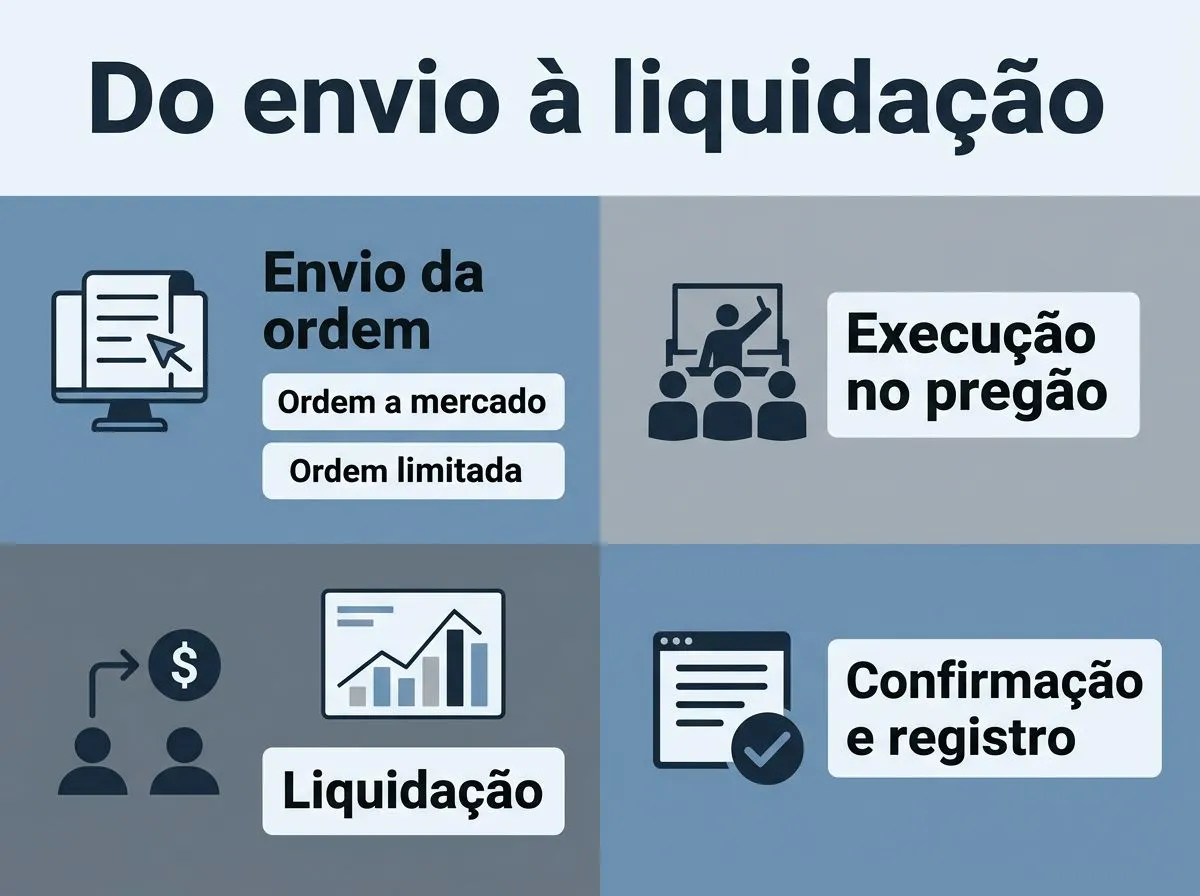
- Order submission: on the brokerage platform, the investor chooses the asset, quantity, and order type. The order is sent to the exchange’s trading environment.
- Execution during the trading session: the trade occurs only when a compatible counterparty appears in the order book. Without a matching price between the buy and sell sides, no trade is completed.
- Market order: seeks immediate execution at the best available price. It is useful when the priority is to enter or exit quickly, but the final price may be worse during periods of low liquidity or sharp fluctuations.
- Limit order: the investor sets the maximum purchase price or minimum selling price. This provides price control, but the order may go unfilled if the market does not reach the desired price.
- Settlement: after the trade, there is a period before the final transfer of money and assets. This interval matters for cash management, rebalancing, and operational risk.
Market orders and limit orders serve different purposes. A market order puts speed first, while a limit order puts price first. Beginners often mix this up and place a market order for an illiquid asset, which can produce a far worse execution than expected. Set a limit too aggressively, though, and the order may never be filled, even if the market trades close to your target price.
Settlement belongs in your planning because the money doesn’t change hands instantly at every stage. That matters if you plan to use the same cash for another purchase, have an upcoming payment, or are working within a tight deadline. In market-based investments, closing a trade during the session doesn’t mean the money becomes available that same second.
How to approach your first purchase without falling into the classic mistakes
Your first purchase of a market-based investment should begin with your goal, not with the latest popular asset. If you’re investing to learn, a highly complex product may create more problems than it solves. CVM Instruction No. 555/2014 and CVM Instruction No. 356/2001 are regulatory references for funds and their administration. For beginners, though, the practical step is straightforward: check the Receita Federal page on market-based investments and read the product’s rules before assuming it works like an ordinary stock.
It’s also useful to distinguish investing from speculation. Buying a market-based investment with a short time horizon means accepting sharp price movements and, in many cases, relatively higher costs on small trades. A longer time horizon doesn’t remove risk, but it can reduce the odds of making an impulsive decision after a temporary decline.
For tax questions, Receita Federal is the main reference for understanding how stock market transactions affect your tax calculation.
Tax treatment depends on the asset type and the nature of the transaction. Beginners shouldn’t assume that every market-based investment has the same tax rate or follows the same calculation process.
For stocks, ETFs, and derivatives, for example, you need to consult Receita Federal’s official page on market-based investments. Tax calculations don’t work the same way in every case.
If you’re unsure, check the official Receita Federal page. For a more specific situation, get help from an accounting professional.
Try this before making your first purchase: explain out loud what you’re buying, where it trades, the total cost of entering and leaving the position, and what must happen for you to make or lose money. If you can’t explain those points, you need to understand the trade better. More courage won’t solve that.
Verification checklist before your first trade
- Your brokerage platform displays the asset, quantity, order type, and total cost before you confirm the trade.
- The order type you chose fits your goal, with a market order for urgency or a limit order for price control.
- The asset has enough liquidity for the size of your position, so you are not relying on a single trade to exit.
- You checked the applicable tax rule with Receita Federal and know what type of transaction you are making.
- You can handle the price swings without panic-selling at the first significant pullback.
Frequently asked questions
Can market-based investments pay dividends?
Some market-based investments can pay income, including dividends, but those payments aren’t guaranteed. With stocks, distributions depend on the company’s results and dividend policy. With funds, they follow the fund’s own rules. Either way, the asset’s price can keep moving up or down, even when it makes regular payments.
Can I start with a small amount of money?
Yes, you can start with a small amount of money. The minimum depends on the asset, brokerage, and trading method. In some cases, you’ll buy one share or unit. In others, you may be able to buy a fraction or a smaller lot. Check what’s available when you’re ready to purchase, and don’t mistake a low unit price for a truly inexpensive investment.
Is variable income suitable for an emergency fund?
Generally, it’s not the best choice for an emergency fund. The price could fall right when you need the money, forcing you to sell at a bad time. For emergency savings, quick access and predictable value usually matter more than exposure to price fluctuations.
What happens if I place an order without enough liquidity?
The order might not fill completely, or it could execute at a worse price than you expected. Execution depends on a compatible counterparty being available in the order book, and the problem is usually more noticeable when the asset has low liquidity. Market orders face more of this risk. A limit order, on the other hand, may simply go unfilled.