
How to Choose the Best No-Annual-Fee Credit Card for Your Profile
How do you find the best no-annual-fee credit card for your situation? Start by comparing the total cost, the condition attached to the fee waiver, and what the agreement lets the issuer charge once the promotional offer ends. “No annual fee” can mean the card is genuinely free, free only while you meet certain requirements, or covered by a benefit that expires. That’s why this guide looks at the actual cost, not just the headline offer.
Key takeaways
- The fee waiver can end if you stop meeting a spending requirement, campaign condition, or relationship requirement, so check the rule before applying.
- The right cost to compare is not just the annual fee: check the total effective cost (CET), one-time fees, and charges that may appear on your statement.
- An offer is reliable only when the official webpage, card agreement, and terms and conditions all say the same thing.
- If you use cash advances, replacement statements, or emergency services, those fees may cost more than the annual fee.
- Reviewing your statement is the final check, because a charge without contractual support can be disputed.
This guide also doesn’t cover the basic card required by regulation, or tiered rewards programs.The focus here is the card you use regularly and want to keep without paying a recurring fee. So the better question isn’t “which card promises to waive the annual fee?” It’s “which card will still be affordable after the promotion ends and the statement arrives?”
What “no annual fee” means and when the waiver can end
No annual fee means the issuer doesn’t charge a recurring card maintenance fee. It doesn’t wipe out other charges or promise that the service will remain free forever. The Central Bank of Brazil Resolution No. 3,919/2010 separates cards into basic domestic, basic international, and premium categories. Premium cards are generally connected to added benefits and rewards. That classification matters in practice because it can affect which charges are allowed and how they’re described in the agreement.
The fee waiver usually comes with a written condition, such as a minimum monthly spending requirement, an existing relationship with the issuer, enrollment in a bundled product package, or participation in a promotional campaign.
If the rule isn’t clear on the official webpage, in the agreement, and in the offer’s terms and conditions, assume the waiver is temporary until you find clear evidence otherwise.
The common mistake is stopping at the “no annual fee” label and missing the clause that brings the fee back once you no longer meet the requirement.
The waiver may also end when the campaign expires, the conditions change, or the offer is suspended, provided the agreement allows it and the issuer gives notice in the required way. For example, the terms for Carrefour, Atacadão, and Sam’s Club cards require at least 30 days’ advance notice before changes to the annual fee. They also state that the issuer may suspend or end the offer. The takeaway is straightforward: the waiver is a contract term, not a permanent feature of the card.
In practice, check three sources: the card’s official webpage, the agreement, and the fee-waiver terms. If even one of them uses vague language, consider that a warning. The card could still work for you, but only if you’re prepared to monitor the maintenance requirement every month.
How to compare the total cost: CET, recurring fees, and the annual fee on your statement
| Comparison criterion | What to look for on the card | How it plays out in practice | Warning sign |
|---|---|---|---|
| Total cost of credit, recurring fees, and charges | Check the total cost of credit, as well as the card's annual fee and service fees for cash advances, replacement cards, and emergency credit evaluations | A card may appear to have no annual fee but end up costing more because of other charges | A promotion focused only on the annual fee, with no transparency about other charges |
| How you actually use the card | Consider your spending patterns, how you pay your statement, installment purchases, and any cash advances | The best card for someone who concentrates their spending may not be the best choice for someone who uses a card infrequently | A benefit that requires high monthly spending and does not fit your spending habits |
| Fee waiver and continued eligibility rules | Check whether the waiver is automatic, conditional, or temporary, and how long it lasts | The fee disappears at first and comes back later if you do not continue meeting the requirement | An offer with no expiration date, no written conditions, or ambiguous clauses |
| Charges on your statement | Review your statement each month to confirm that no annual fee or related charge appears | An improper annual fee charge may appear as a one-time entry or be split into installments | A charge that does not match the offer you accepted or the applicable terms |
The choice comes down to this: the least expensive card is the one that lowers your total cost in real-world userather than the one that simply turns one line on the bill to zero. The Central Bank of Brazil and the logic behind the CET support that approach. A single fee can hide costs that show up later, especially when you take cash advances, split purchases into installments, or pay for occasional services.
If you rarely take cash advances, request a replacement statement, or use an emergency credit assessment, those fees may have little effect on your decision. But if those transactions are part of your normal spending, a no-annual-fee offer could cost more than another card with a lower recurring charge and steadier terms. What matters is the amount left on the bill at the end of the month, not the offer’s headline.
The statement is the final reality check. The charge description should match the agreement and the offer terms. If “annual fee,” “annual fee installment,” or a similar charge appears without support in those documents, you have a reasonable basis to dispute it.
The Central Bank of Brazil lists, for example, MIDWAY S.A. with an annual fee of 191.88 for a basic national card over 365 days, while RECARGAPAY Instituição de Pagamento Ltda. lists an annual fee of 0.00 for a basic national and international card. That’s why comparing only the “no annual fee” label doesn’t tell you enough.
Sicoob recommends checking the interest rate, CET, and installment amounts before you decide. The same logic applies here: waiving the main fee does not help much if the rest of the package is costly. Ask yourself one practical question: what will it cost to keep and use this card for 12 months?
How to confirm the terms in the contract, terms and conditions, and official page
- Open the card's fee and benefits schedule and look for the annual fee, the waiver requirement, and the validity period.
- Check the issuer's official page and the institution's fee schedule at the Central Bank of Brazil to confirm whether a charge exists and what amount was reported.
- Read the clauses about advance notice, suspension, closure, loss of the waiver, and any prorated charge in the event of cancellation.
- Save a screenshot, PDF, or offer reference number so you can compare it with the credit card agreement and dispute an improper annual fee charge if one appears.
This is the point where a genuinely good offer stands apart from a confusing one. The contract, terms and conditions, and official page should all match, since those documents establish whether the issuer can charge or waive the fee. If they do not, rely on the clearest document and, if needed, ask the issuer for a formal correction.
Check whether the waiver depends on a condition you could easily miss, such as a minimum monthly spending requirement. People often sign up without noticing, then spot the charge when the first statement arrives “outside the usual pattern.” By then, the annual fee no longer feels like a benefit. It feels like the price of overlooking the fine print.
If the card comes with a limited-time promotion, note the end date somewhere you will see it. Does continued use come with a specific rule? Write that down, too. And if the contract refers to prorated cancellation effects or advance notice, read those terms before accepting the offer, not after the charge shows up.
How to decide which no-annual-fee card fits your profile
The best no-annual-fee card is one that still makes sense after the first month, given how you spend and pay. Someone who puts most purchases on one card and pays the statement in full may find a minimum-spending waiver worthwhile. Someone who uses a card only occasionally may find that a hard-to-maintain benefit turns into a trap instead of a savings.
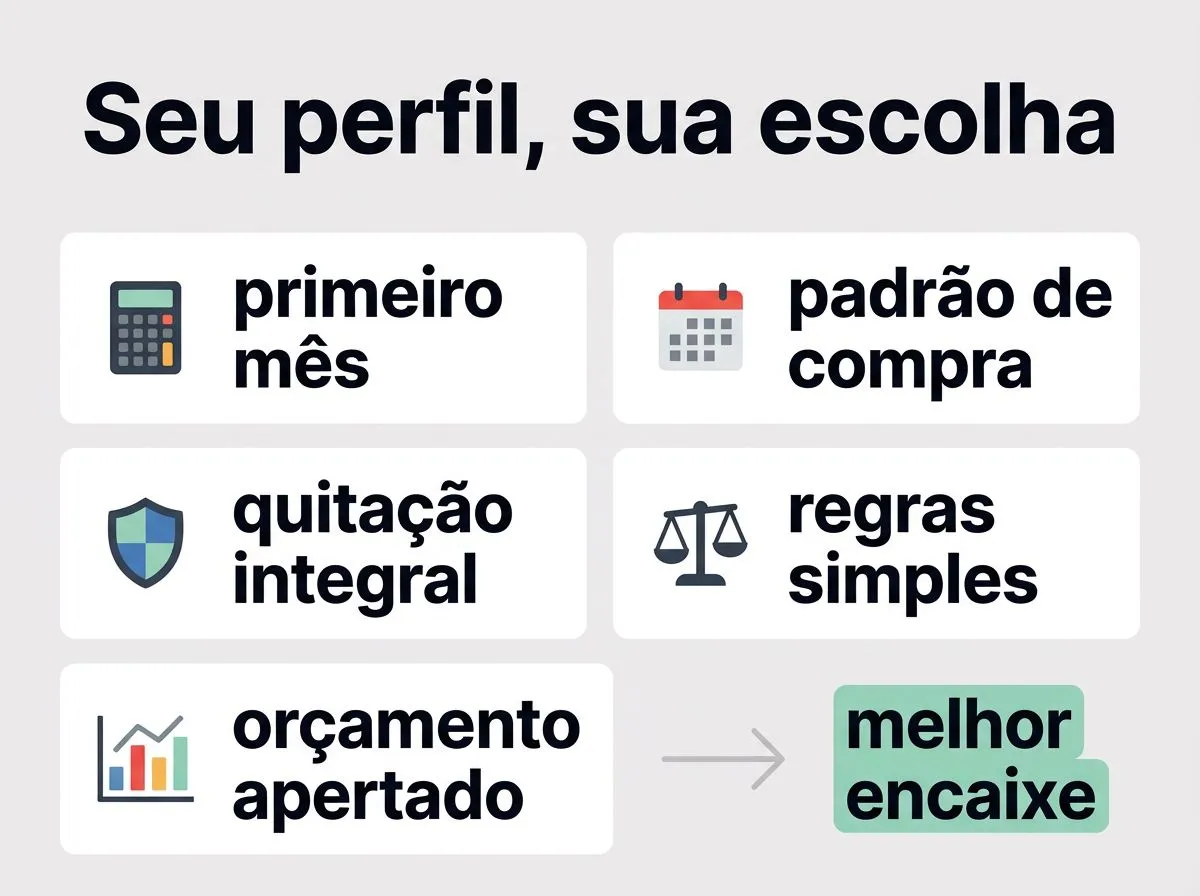
For predictable costs, look for rules that are simple and clearly written. If the card depends on a product bundle, switching accounts, or monthly goals, find out what it will cost if you lose that qualifying condition. That number is what can turn “free” into expensive. A good card should be easy to keep without constant effort.
With a tight budget, stability matters most: your statement should not bring surprises, the requirements should be realistic, and you should not pay for a service you never use. If convenience and perks matter to you, check whether they justify the charges that may come later. The benefit works only if the numbers still make sense after the promotion ends.
Retailer credit cards and digital wallets can be useful, but their benefits often come with rules worth reading closely. For products linked to retailers such as Carrefour, Atacadão, and Sam’s Club, the offer may change with advance notice. At institutions such as MIDWAY S.A. and RECARGAPAY, the fee schedule published by the Central Bank of Brazil can help you verify whether “no annual fee” is genuinely free and whether other charges apply.
The final choice is fairly simple: pick the card you can keep at the lowest total cost and with the smallest risk of a surprise on your statement. If two cards seem comparable, go with the one that has the clearer agreement, more transparent billing, and a fee-waiver requirement you can maintain without much effort.
Verification checklist before applying
- The card’s official page should clearly state whether the annual fee is waived, conditional, or promotional, and how long that arrangement lasts.
- The agreement and terms should describe the fee-waiver requirement without vague phrases such as “benefits subject to change.”
- The fee schedule published by the Central Bank of Brazil should confirm whether an annual fee applies and which other fees may appear.
- Your statements for the first few months should match exactly what was promised, with no annual fee charged by mistake and no installment fee applied without a provision in the agreement.
Frequently asked questions
Is a no-annual-fee credit card always worth it?
It is worthwhile only if the total cost is lower than your other options for the way you actually use the card. That is why the key comparison looks at what remains after 12 months. A card may waive the annual fee and still become expensive through charges for cash advances, duplicate statements, or emergency credit reviews.
Can I be charged an annual fee even if I cancel the card?
You may be, if the agreement allows a prorated charge for the period when the card was active or explains how cancellation affects the fee. The written terms control the outcome: check the offer, agreement, and terms carefully. The waiver could end when the campaign expires or when you stop meeting a qualifying condition.
What should I do if an annual fee appears on my statement even though I never accepted it?
Contact the issuer’s customer service right away, dispute the charge, request a case number, and ask for the improper amount to be corrected. Your statement should match the agreement, terms, and official page. Save proof of the offer so you can compare it with the charge and file a formal complaint if necessary.
How do I know whether the fee waiver depends on a minimum spending requirement?
You will usually find this information in the offer’s terms, on the official page, and in the agreement, together with the validity period. If one of those documents leaves the rule unclear or omits it, treat the waiver as conditional. Request written confirmation before applying, because this is the requirement people most often lose track of in actual use.