
How Interest Rates Affect Your Investments and Your Wallet
Put simply, an interest rate is what it costs to use money over time. In Brazil, the main macroeconomic benchmark is the Selic rate, set by Copom at the Banco Central do Brasil. It influences inflation, credit, and fixed-income investmentsthough those effects don't reach everyone alike or appear overnight.
Key Takeaways
- When interest rates rise, borrowing becomes more expensive and consumer spending tends to slow, with the effects emerging over time rather than on the same day.
- In fixed income, longer-term bonds with locked-in rates fluctuate more, especially when the Selic rate changes before maturity.
- What matters for your wallet is the real rate, meaning the return after inflation, not just the offer's nominal percentage.
- For borrowing, the final rate depends on the term, risk, collateral, down payment, and fees, so the right comparison is the total effective rate.
- If you have expensive debt and high interest rates, paying it off or reducing the balance often makes more sense than pursuing higher-risk returns.
This guide explains the Selic rate and what it means in practice. It doesn't cover mortgages, payroll-deducted loans, or credit card balances in detail, since each type of credit has its own rules and costs and deserves a separate analysis.
How Interest Rates Affect Inflation, Prices, and Economic Activity
As interest rates climb, borrowing costs more, consumer spending usually cools, and companies tend to be more careful about investing. This is the monetary policy transmission channel outlined by the Banco Central do Brasil: higher real interest rates reduce pressure on demand and help keep inflation in check.
The basic mechanics are easy to follow, but the effects don't show up all at once. The Banco Central do Brasil explains in its materials on monetary policy transmission mechanisms that changes in the Selic rate also influence expectations. Those expectations can shape decisions immediately, well before the full effect reaches prices and economic activity.
In real-world pricing, the Selic rate is only one piece of the picture. The final cost of a loan, financing arrangement, or installment purchase also reflects the term, the customer's risk, collateral, down payment, and the institution's pricing policy, as shown on the page Interest Rates from the Central Bank of Brazil.
That’s why a useful comparison begins with the benchmark and ends with the transaction's effective rate. The Selic rate sets the broader direction, but the rate that reaches your wallet has already been adjusted for the spread, risk, and fees.
How the Selic rate affects fixed-income investments, prices, and mark-to-market valuation
| Bond type | Typical response when interest rates rise | Term and sensitivity | Mark-to-market valuation | Most common use |
|---|---|---|---|---|
| Tesouro Selic | Tends to experience little mark-to-market volatility because it tracks the benchmark interest rate | Best suited for short-term goals and liquid reserves | Lower price volatility compared with fixed-rate and IPCA+ bonds | Emergency savings and short-term cash |
| Fixed-rate bonds | The price falls when the new market rate rises above the locked-in rate | The longer the term, the greater the sensitivity | More price volatility before maturity | Investors who want to lock in a rate and can hold the bond until maturity |
| IPCA+ | The price varies with the real interest rate demanded by the market | Longer-dated securities are more sensitive | Fluctuates considerably in long-term securities | Purchasing-power protection over the medium and long term |
| CDB | It can track the CDI or carry a fixed rate, so the reaction depends on the indexing | Long-term and fixed-rate CDBs fluctuate more | They are also subject to mark-to-market pricing in some cases | Emergency savings, income, and goals with a defined time horizon |
| Debentures | They react according to the contracted rate and term | A longer term tends to increase sensitivity | They can also fluctuate before maturity | Financing medium-term goals, with greater risk than government securities |
The basic rule is easy to remember: the longer a security's term and the more fixed its rate, the more its price can move when interest rates change. The portal itself Government Securities, on gov.br Investidor, explains that Tesouro Selic was designed for emergency savings because it has less exposure to these price swings. Fixed-rate securities lock in a rate, so they're more sensitive to market changes.
Mark-to-market pricing means adjusting a security's price to the value it would reasonably have today, based on current interest rates. If rates rise after you buy, a fixed-rate security purchased earlier may be worth less in the secondary market. If rates fall, the reverse can happen.
That price movement matters most when an investor has to sell before maturity. If the security is held until maturity, it pays the contracted return, provided the product's rules are followed and the issuer honors the payment.
Nominal Rate and Real Rate: What Remains of the Return After Inflation
The nominal rate is the figure shown in an advertisement, statement, or offer. The real rate is what's left after inflation is deducted. Put another way, it shows how much purchasing power the money actually gained.
This changes the way you should judge any investment. A high nominal return can deliver very little in real terms if inflation is also high during that period. The reverse can happen too: a moderate nominal rate may preserve more purchasing power when prices barely rise.
The most common mistake is comparing investments or debts by the gross percentage alone. You also need to consider the term and the index that reduces your purchasing power. For your budget, the number that matters is not only what appears on the screen, but what that money will actually buy when the period ends.
When the investor evaluates Tesouro SelicCDBs, debentures, or any other floating-rate security, the question that matters is different: how much will I have left after taxes and inflation when I need to use the money?
How interest rates affect the cost of credit
- Compound interest makes debt grow based on the balance, late payments, and charges that have already accumulated. With long-term installment plans, even a short delay can significantly increase the final cost because the balance grows month after month.
- The advertised rate is not the total cost. The figure that best shows the price of credit is the Total Effective Cost, or CET, which combines interest, fees, insurance, and other charges included in the transaction.
- To compare offers, use the same basis. A low monthly rate may look attractive, but become more expensive when converted to an annual rate or combined with the charges included in the CET.
- The average rates published by Banco Central on its Interest Rates page are useful as a market reference, but the rate on your contract depends on your credit history, collateral, term, and the profile of the transaction.
- If credit is expensive and the investment return is uncertain, paying off the debt is usually the more defensible decision. Reducing a certain cost generally beats pursuing a nominal gain that is still hypothetical.
In practice, credit gets more expensive for two reasons at the same time: the benchmark rate goes up, and the financial institution adds its own costs and risk premium. That’s why the final rate paid by a consumer is almost never the same as the Selic rate. The total cost can sit well above the bank’s funding rate.
Before you sign, check the CET in the contract, statement, or credit offer. Then compare the debt’s final payoff date, not only the monthly payment. With financing, a lower payment can conceal a much higher total cost.
How to use interest rates to choose whether to invest, save money, or pay off debt
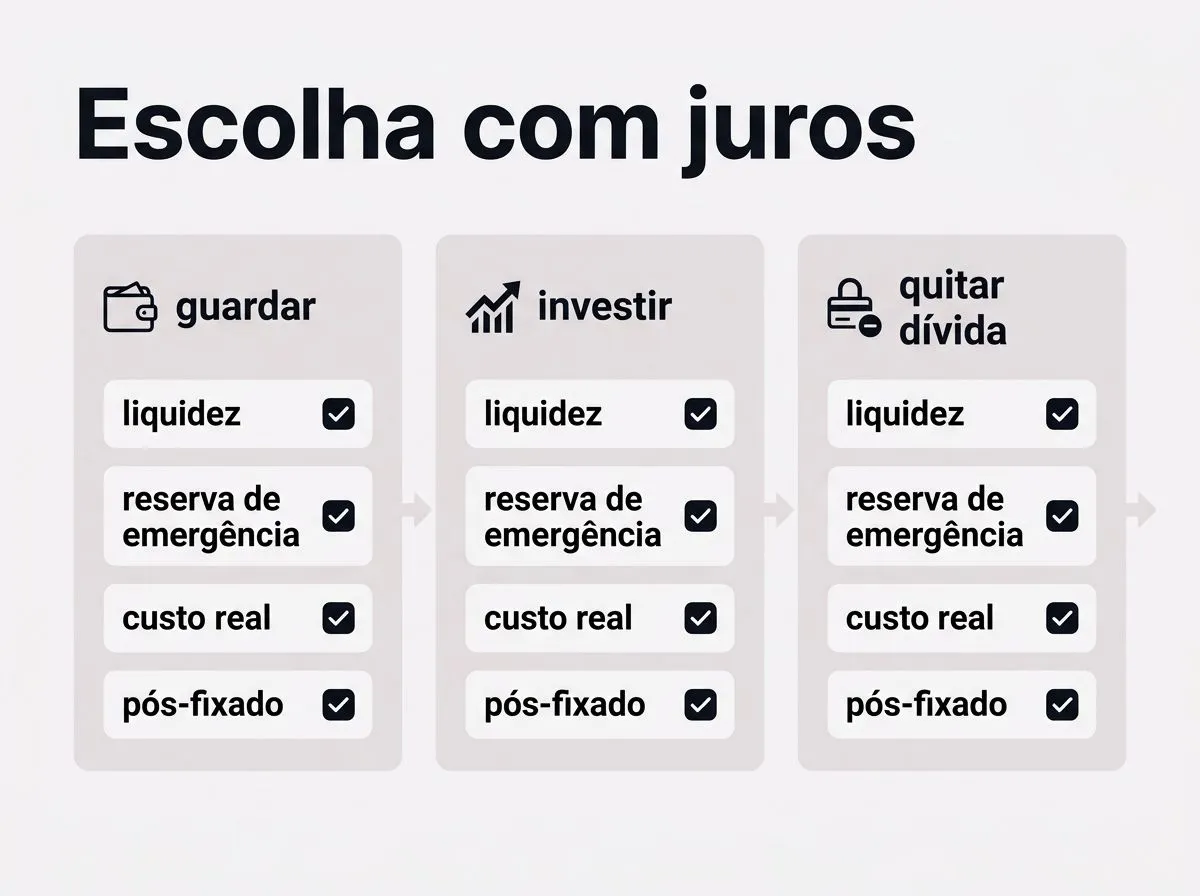
- If the money needs to remain available, liquidity comes first. In that case, an emergency fund in Tesouro Selic or another highly liquid floating-rate investment makes more sense than locking up funds in a long-term security.
- If the debt has a high CET, paying it off may earn more than any conservative investment after taxes. The benefit is immediate: you stop paying high interest.
- If the goal is to protect purchasing power over the medium and long term, inflation-linked bonds or floating-rate securities with a competitive rate may make more sense, as long as the term matches your needs.
- If you can tolerate price fluctuations, a fixed-rate security can lock in an attractive rate when the market expects interest rates to fall. If you may need the money sooner, mark-to-market risk weighs against that choice.
- If the choice is between investing and paying down debt, compare three numbers: the debt's CET, the investment's net return, and how long the money will remain invested.
The practical rule is straightforward: keep your emergency fund separate from money you’ve set aside for a goal. Next, find the debt’s actual cost. Only then compare the investment’s net return with the amount you’d save by paying down the debt.
When interest rates are high, floating-rate investments tend to look more attractive because they follow the benchmark and earn more on idle cash. Financing gets more expensive at the same time. So one market scenario can help one side of your balance sheet while putting pressure on the other.
If you’re starting out, don’t treat predicting Copom’s next move as the decision that determines everything. Match the term, liquidity, and cost instead. Short-term money needs protection, expensive debt usually calls for faster repayment, and long-term investing requires enough discipline to ride out fluctuations.
Interest rates ultimately affect your finances in three ways at once: they change the cost of credit, influence the nominal return on investments, and either reduce or protect purchasing power through inflation. The right choice depends on which of those effects matters most in your situation today.
Frequently asked questions
Where can I check the average interest rate on credit in Brazil?
Check the Central Bank of Brazil’s Interest Rates page. You’ll find averages by credit category there, along with the effective rate, which already includes the charges applied to each transaction. It’s the better reference for comparing credit because a bank’s advertised rate may not reveal the contract’s full cost.
Is the Selic rate the same as the interest rate I pay the bank?
No. Selic is Brazil’s benchmark interest rate and a market reference, but the final cost of credit depends on the transaction type, term, customer’s risk profile, collateral, and fees. That’s why consumers usually pay more than the Selic rate.
Why can a fixed-income security lose value before maturity?
Its market price changes as interest rates move. If rates rise after you buy a fixed-rate or longer-term security, its value will generally fall in the secondary market. If rates drop, the opposite may happen. This risk becomes much more important if you need to sell before maturity.
What is the practical difference between a nominal rate and a real rate?
The nominal rate is the percentage shown in an offer or on an account statement. The real rate tells you what remains after inflation, meaning the actual gain in purchasing power. Put simply, it shows whether your money truly became more valuable, rather than merely displaying a larger number on the screen.