
What Is Bitcoin and What Role Does the Asset Play in Today’s Financial Market?
Bitcoin is a digital crypto asset issued without a central public authority. No government backs it, and it shouldn't be confused with a bank account balance or fiat currency. In practice, you can hold and transfer it as an asset, but its use for everyday payments remains limited, as the European Central Bank and SEC Investor.gov note.
Key takeaways
- Bitcoin’s supply is capped at 21 million units, and new coins enter the network through mining rewards.
- The halving event occurs every 210,000 blocks and cuts new issuance in half.
- Bitcoin can serve as a satellite asset in a portfolio, but not as an emergency fund or an automatic substitute for fixed-income investments.
- Losing the private key means losing access to the asset, so custody and security are critical before buying.
What exactly is Bitcoin?
Bitcoin is a digital unit designed to circulate outside the traditional monetary system. The European Central Bank describes it as a crypto asset issued without a central public authority. SEC Investor.gov classifies it as a decentralized virtual currency that functions as money in some contexts, but it has no government or central bank backing.
That sets Bitcoin apart from official currencies such as the euro or Brazilian real, which have an issuer, legal-tender status, and monetary policy of their own. It also separates Bitcoin from the balance shown in your banking app. That balance is a liability of the financial institution, while Bitcoin is an asset you control directly on the network, provided you have the access keys.
The distinction matters because it changes the risks you're dealing with. Fiat currency raises questions about purchasing power and monetary policy. Bitcoin adds volatility, custody, technology, and market acceptance to the picture. A common beginner mistake is to treat Bitcoin as a digital version of the Brazilian real, even though it behaves more like a tradable asset than money held in a bank.
How Bitcoin Works in Practice
Bitcoin runs on a public, distributed record known as the blockchain. Rather than relying on one bank to maintain the ledger, the network copies its transaction history across many computers. Each new group of transactions is placed in a block, which the network validates through consensus.
The network validates transactions through proof of work. Miners compete to solve a computational problem, and the miner who finds a valid solution proposes the next block. That process makes fraud harder in practice, but it also uses energy and depends on technical infrastructure.
A typical transaction starts when you send Bitcoin from one wallet to another. The network checks that the source balance exists, groups the transaction with others waiting to be processed, and adds it to the public history after the transaction is confirmed in a block. It isn't instantaneous in the way a bank transfer may seem, since confirmation depends on block inclusion and the chain continuing to advance.
For investors, this has two practical consequences. First, custody matters because losing the private key means losing access to the asset. Second, settlement is effectively irreversible. Check the recipient's address carefully before you confirm the transaction.
How Bitcoin Issuance Happens Over Time
New bitcoins are created inside blocks validated by the network. The miner's reward pays the miner for this work, and the reward is periodically reduced in an event called the halving. This mechanism cuts new issuance in half at scheduled intervals.
- Each validated block can generate a Bitcoin reward for the miner who added it to the chain.
- Every 210,000 blocks, this reward falls by 50%, reducing the rate of new issuance over time.
- The total supply is capped at 21 million units, reinforcing the asset’s perception of scarcity.
That supply limit is key to understanding why people often compare Bitcoin with scarce assets. The Santa Catarina Court of Justice summarizes the feature by noting that issuance is capped at 21 million units by code, alongside high volatility and a 100% digital nature. For investors, the practical takeaway is simple: scarcity doesn't remove risk. It changes how the asset's supply behaves.
Programmed scarcity helps explain the speculative interest in Bitcoin, but it doesn't guarantee that the price will rise. When an asset has a rigid supply, its price can move more sharply as demand changes quickly, because no issuer can increase or reduce the amount in circulation to soften the move.
What role does bitcoin play in a portfolio and the financial market
Bitcoin may fit as a small, high-risk part of a portfolio, but it shouldn't automatically replace cash, fixed-income investments, or an emergency fund. Its role is the key distinction: if you include Bitcoin, it functions as a tactical or satellite asset, not as the foundation of a wealth-preservation strategy.
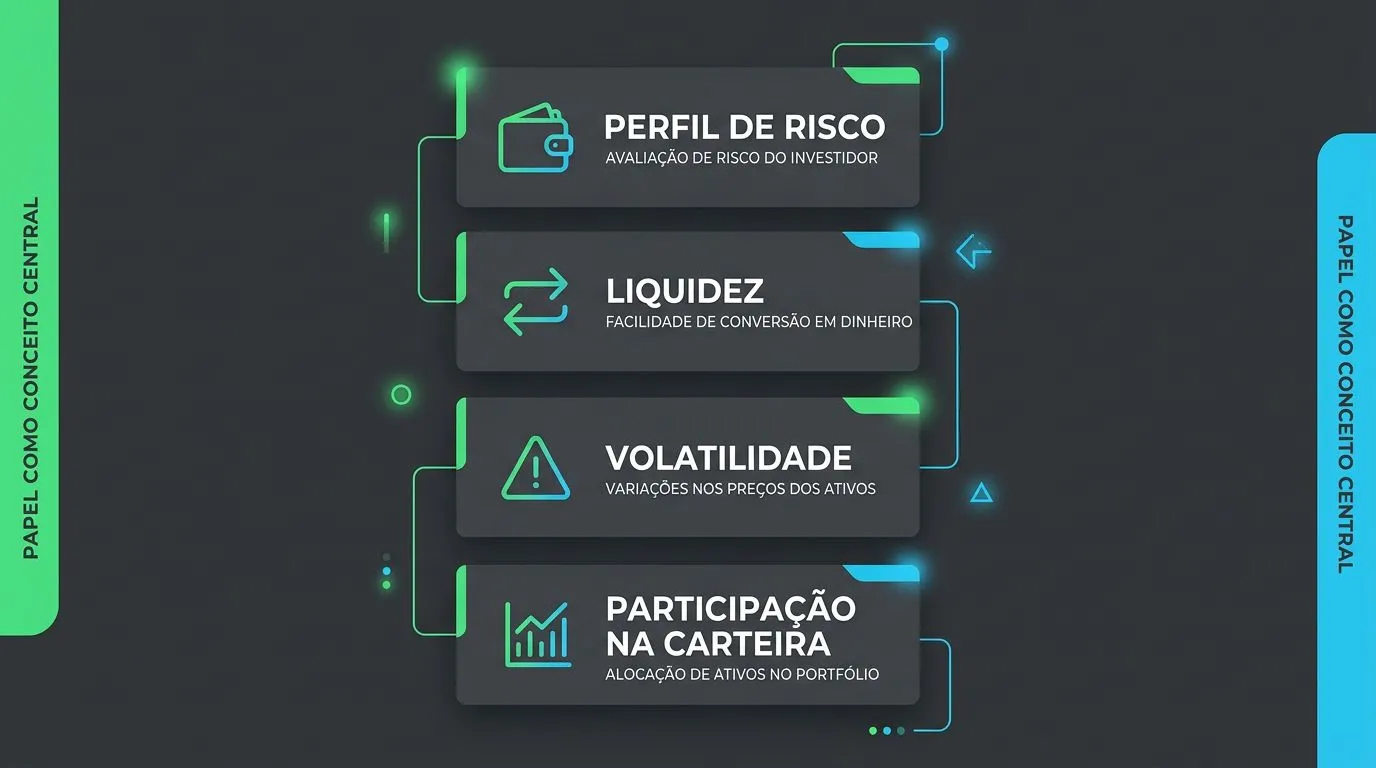
| Analysis criterion | What tends to happen to bitcoin | What this means for the portfolio |
|---|---|---|
| Liquidity and trading | It is traded on multiple platforms and can be converted relatively quickly, but this depends on the exchange, trading hours, and market depth. | This can make it easier to exit the position, but it does not eliminate execution risk during periods of market stress. |
| Volatility and risk | It fluctuates more than official currencies and typically reacts strongly to changes in risk appetite. | It requires a small position and the ability to tolerate significant losses without compromising core goals. |
| Comparison with more traditional assets | It behaves differently from cash, government bonds, and stocks, and it does not serve the same defensive role as a bond held to maturity. | It serves more as marginal diversification than as the primary means of protecting wealth. |
The clearest insight comes from comparing Bitcoin with traditional portfolios. J.P. Morgan Private Bank observed that Bitcoin fell more than stocks during risk-off episodes and did not consistently protect portfolios when equity markets weakened. For beginners, the practical lesson is important: putting too much of a portfolio into Bitcoin can raise its overall risk.
There's another point worth keeping in view: liquidity doesn't equal stability. An asset may trade actively and still experience large price swings. Anyone considering Bitcoin exposure should decide ahead of time how much loss they can tolerate and what maximum share of their portfolio they are willing to see fluctuate sharply.
How regulation views the crypto ecosystem
Regulation generally addresses three separate layers: the asset, custody, and the investment offering. Bitcoin itself is one matter. The company holding your keys is another. A financial product that promises exposure to Bitcoin's price is a third. Confusing these layers can lead to poor decisions because the legal and operational risks differ at each one.
SEC Investor.gov warns that Bitcoin and other virtual currency investments can attract scams and high-risk proposals. Beginners may be especially vulnerable because unfamiliar products can make it easier to lower their guard. The European Central Bank, for its part, stresses that Bitcoin isn't issued by a central public authority and doesn't carry the same level of trust as an official currency. Put together, the message is clear: oversight isn't a guarantee of complete protection.
In practice, regulatory treatment varies by country, but the main concerns usually include transparency, advertising, fraud prevention, and custody rules. If the offering comes through a brokerage, bank, fund, or derivative, investors should identify who is responsible for the structure, understand the product's risks, and determine where the applicable legal protections take effect.
It also helps to keep the asset separate from the tool used to manage it. Wallets such as MetaMask give you control over digital assets, but self-custody demands careful procedures. Lose your password, key, or recovery phrase, and access may be gone permanently. In crypto, technology can’t replace good operational discipline.
Verification checklist before buying or researching Bitcoin
- Confirm that you want exposure to Bitcoin's price, rather than to its use as a payment method, because its role as a means of payment remains limited.
- Check where the asset will be stored and whether custody remains with you, a brokerage, or another intermediary.
- Set the maximum percentage of your portfolio that can fluctuate without compromising your emergency fund, short-term goals, or bill payments.
- Read the product or platform's rules, including fees, spreads, withdrawal availability, and the access recovery process.
If this guide helps readers make a better-informed decision, it’s done its job. Bitcoin isn’t a promise of profit or ordinary bank money. It’s a scarce, volatile, and technically distinctive digital asset that may have a place in some portfolios, as long as the risks are clear upfront.
Frequently asked questions
Is Bitcoin considered an official currency?
No. Bitcoin is a crypto asset, not something issued by a central public authority, and it isn’t legal tender like the Brazilian real or the euro. That distinction affects how people use it and the risks involved. Bitcoin doesn’t work like a bank balance or a government-issued fiat currency.
Can you pay for everything with Bitcoin in everyday life?
Not broadly. The article explains that Bitcoin’s role as a payment method remains limited, so it doesn’t replace official currencies in everyday life. For beginners, the practical takeaway is simple: Bitcoin is generally treated more like a tradable asset than money for routine purchases.
What happens when a halving occurs?
The block reward is cut in half, which slows the rate at which new bitcoins enter the network. This happens every 210,000 blocks and helps preserve the asset’s scarcity. It doesn’t remove volatility or guarantee that the price will rise.
Is Bitcoin the same thing as blockchain?
No. Blockchain is the distributed public ledger that supports the network. Bitcoin is the asset that moves across that infrastructure. Put simply, blockchain provides the validation structure and transaction history, while bitcoin is the digital unit people trade and transfer on it.
How can an investor store bitcoin more securely?
In general, the choice is between self-custody, an exchange, or another intermediary, with private-key management requiring close attention. Losing a password, key, or recovery phrase can mean losing access to the asset altogether. That makes operational security just as important as the platform you select.