
52-Week Challenge: How to Save Money Gradually
How can you use the 52-week challenge to save money without putting too much pressure on your budget? The answer is simple: choose a clear goal, start with manageable contributions, and raise the amount gradually until you’ve made all 52 deposits. This approach tends to work well for people who want to build a savings habit without making drastic cuts. This guide doesn’t cover retirement or long-term investing. It focuses on steady saving for a specific goal.
Key takeaways
- Start with a goal divided by 52: the weekly amount needs to fit your budget from the very first week.
- If the contribution grows too large and starts squeezing your fixed bills, lower the step-up amount before abandoning the plan.
- For an emergency fund, liquidity matters more than returns, so an easily accessible account usually makes more sense.
- If the money can stay untouched for longer, investing can help keep up with inflation and benefit from compound interest.
What saving money means and how to set the challenge goal
Here, saving money means deliberately setting aside a certain amount, within the budgetfor a specific goal. Without one, the challenge can turn into a random deposit that’s easy to abandon halfway through. A clear goal gives you a reason to keep going and shows what the money will actually represent in your life.
The most useful goal is usually one of three things: an emergency fund, a planned purchase, or a cushion for unexpected expenses. An emergency fund can cover a real problem, such as car repairs or medical bills. A planned purchase might be a trip, electronics, or a course. A fund for unexpected expenses gives you some breathing room during tight months. If the goal stays vague, the money starts competing with daily expenses and often disappears before the challenge is over.
To calculate a weekly amount, divide the total you want to save by 52. If that number puts too much strain on your budget, lower the target or give yourself more time. The challenge only works when it fits without putting essential bills at risk. A small amount you can contribute consistently is more useful than an ambitious start that ends in frustration.
In practice, the most common mistake is deciding how much to save each week before deciding what the money is for. Start with the reason, then do the math. If you need an easy entry point, choose an amount that feels comfortable, such as R$ 5 or R$ 10 per week, and increase it only after the routine feels stable. That helps prevent the feeling that you’re saving “for nothing,” which can weaken your discipline early on.
How to build a realistic progressive 52-week plan with increasing contributions
A progressive plan begins with small contributions and increases them in a controlled way. That keeps the pressure lower at the start and gives you time to build the habit. With the 52-week challenge, this approach often works better than trying to set aside a large amount during the first few months.
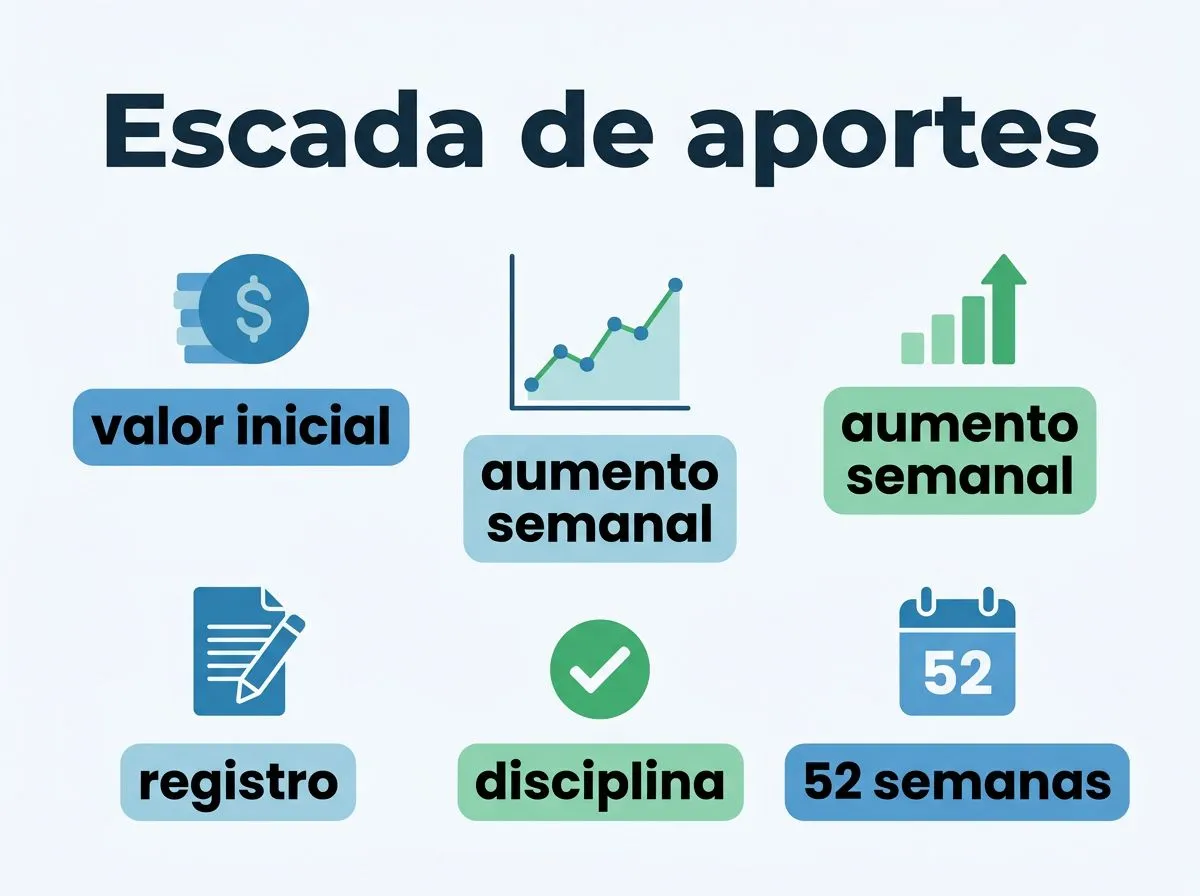
- Choose a comfortable starting amount that will not compete with rent, groceries, and fixed bills.
- Set a small weekly increase, or use a contribution ladder that rises in a predictable way.
- Record each deposit in a spreadsheet, notebook, or budgeting app.
- Set the money aside as soon as you get paid, before it gets mixed in with the month's expenses.
- Review the plan if your income changes, so the challenge does not turn into frustration.
Here’s a simple example: start with $5 in week one and add $5 each week. By week 52, the final deposit reaches $260, and your total savings comes to about $6,890. Too demanding? Use smaller increases. If your budget has more room, move up the schedule faster or add extra deposits during weeks when your income is higher.
A tool such as Organizze, a spreadsheet, or even paper and a pen can do the job. What matters is being able to see your progress. Once the money becomes “invisible,” the challenge can quickly lose momentum. According to the Poupa52 app page, the app is designed to help users build an emergency fund gradually, which makes it a good fit for anyone who prefers a simple, visual system.
The classic mistake is raising your contributions too quickly because you’re excited, then taking some of the money back to pay for everyday expenses. If the challenge money keeps getting redirected, the target was higher than your budget could really support. Start smaller if you need to. Completing the full cycle is better than making a big promise and stopping halfway through.
Saving in an account or investing: what changes with risk, liquidity, compound interest, and inflation
| Where the money goes | Liquidity | Risk | Compound interest and inflation | When it makes the most sense |
|---|---|---|---|---|
| Interest-bearing account or available balance | High, with quick or immediate access | Low, but returns are generally limited | Better protects access to the money than the growth of its value | Emergency fund and very short-term goals |
| Brokerage account, fractional shares, ETFs, or PPR | Varies depending on the product | Greater volatility, especially with stocks and ETFs | You can benefit from compound interest, but inflation and volatility matter | Longer-term goals, when the money can stay invested |
If you’ll need the money soon, keeping it in your account usually makes more sense. Here, easy access matters more than chasing the highest possible return. For an emergency fund, liquidity comes before returns.
With a longer timeline, when you won’t need the money at a moment’s notice, investing the surplus may help protect its purchasing power more effectively. The Financial Literacy reminds readers that fractional shares and ETFs allow you to start with a small amount, which makes the habit practical even when your contributions are modest. That context highlights some investment options, but it doesn’t replace choosing the purpose of the challenge. The key point is straightforward: compound interest needs time, while inflation gradually reduces the value of money left idle for long periods.
Investing only makes sense if market fluctuations won’t interfere with your goal. Fractional shares and ETFs can rise and fall in value. PPRs work differently, with a closer connection to time horizons and discipline, and they also have their own withdrawal rules and costs. For an emergency fund, liquidity and security remain more important than chasing the highest return.
Here’s a practical rule: if you might need the money within the next few months, keep it accessible. If you won’t need it for a long time, consider investing the surplus. A checking account or an easily accessible portfolio keeps the money available for emergencies. If your contribution grows, increase the weekly amount before changing the purpose of the money. An investment account makes sense when the timeline gives your money time to work without putting the plan at risk.
The 52-week challenge works because it turns a vague goal into a routine you can follow. Make three decisions: your starting amount, how quickly it will increase, and where the money will stay. If you need immediate security, keep it in an account. If you’ve already built a foundation and can accept fluctuations, you may direct the surplus toward investments that match your timeline. The strongest plan is the one you can finish in week 52, not the one that looks impressive on paper.
Frequently asked questions
Can I start the 52-week challenge with amounts smaller than 1 real per week?
Yes. You can start with a smaller amount, provided it fits your budget and you can maintain the pace through week 52 without putting essential bills under pressure. A small, consistent contribution is usually more effective than an aggressive amount you abandon halfway through.
Do I need to follow the increasing contribution schedule every week?
No. You can reverse the order, raise the amounts in bigger steps, or even schedule pauses, provided the progression still fits your income. The goal is to finish all 52 weeks with a plan you can actually follow, not to stick to a rigid sequence.
Is the 52-week challenge suitable for an emergency fund?
Yes, as long as you keep the money somewhere secure and liquid enough to access quickly. For an emergency fund, easy access matters most. Putting the money in an account or investment that makes withdrawals difficult defeats the purpose.
What if I miss a week of contributions?
You can catch up the following week, split the amount, or change the sequence. What matters is not letting a one-time delay derail the whole plan. The challenge only works when you keep the routine going through the end.
Is keeping money at home worse than leaving it in an account?
Keeping cash at home can provide a visible reminder and help build discipline, but an account is usually easier to organize and more secure. The article also notes that if the money sits untouched for a long time, an account makes sense only when the amount has a clear purpose and hasn't simply been forgotten.