
Cryptocurrency for beginners: How to start investing safely
For beginners, cryptocurrencies are digital assets you buy and hold using a trading platforma wallet, and a few basic security precautions. If you want to start with less risk, keep the essentials simple: choose a reputable exchange, enable strong account protection, and understand who controls the keys to your balance before transferring larger amounts.
Key takeaways
- Your first purchase should be small and made only after enabling two-factor authentication.
- If the platform does not clearly show its fees, withdrawal process, and support options, the operational risk is already high before you make a deposit.
- Custodial storage simplifies getting started, while non-custodial storage requires knowing how to manage a seed phrase and create a backup.
- Choosing the wrong transfer network can make a transaction more expensive or even cause the transfer to get stuck, so verify the asset and address before confirming.
This guide is about taking your first step carefully, not learning advanced strategies or trading constantly. The aim is to avoid operational mistakes, scams, and confusion around buying, custody, and transfers. Those are the problems that can hurt beginners most.
How to assess risk and legitimacy before opening an account
Before sending money, assess an exchange's track record, transparency, and warning signs. If a platform promises easy returns, pushes you to deposit right away, or communicates through unofficial channels in an overly casual way, take that as a warning. It isn't an opportunity.
- The platform's reputation and operating history, including its time in the market, episodes of instability, and recurring complaints
- Transparency about custody, fees, withdrawals, deposits, and official support channels
- Warning signs: aggressive promises of returns, pressure to deposit immediately, and overly informal communication
- Registration, compliance, and identity verification, when applicable, as part of the onboarding process
In practice, compare the information an exchange publishes with reporting from reliable editorial sites and official agencies. Banco Central do Brasil does not supervise cryptocurrencies in the same way it supervises traditional bank deposits. That difference matters when you're assessing risk, so don't assume you have the protection associated with a checking account. Receita Federal do Brasil handles taxes and reporting, which means you shouldn't treat a crypto purchase as invisible to the authorities.
Here's a useful first filter: Can you find the fees, withdrawal policy, official support channel, and identity verification process without going on a treasure hunt? If not, the platform is already starting badly.
Step-by-step: How to make your first purchase without operational mistakes
Keep your first purchase small, and make it only after your account has been verified and basic security features are active. You're testing the process, learning the costs, and confirming where the asset will be held once you buy it.
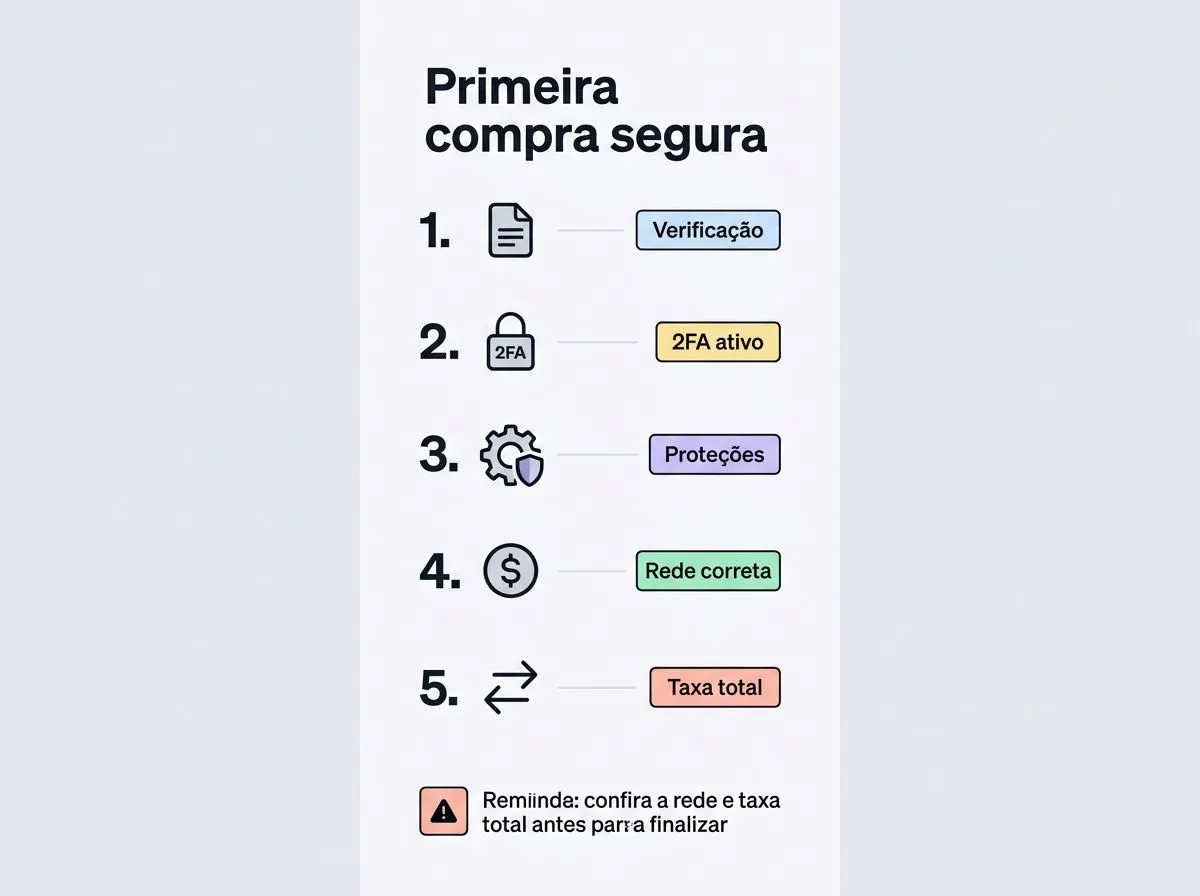
- Create an account on your chosen platform and carefully complete identity verification, paying close attention to the information you submit
- Enable two-factor authentication and review your account’s security protections, including your email and password
- Make a small first purchase to test the process, fees, and processing time
- Decide where your assets will stay after the purchase, either on the exchange itself or in a wallet you control
What to check before clicking Buy
Check the asset name, transfer network, total fees, and the net amount leaving your account. Picking the wrong network is a classic cryptocurrency mistake. Depending on the asset and address combination, the transfer could be delayed, cost more, or become irreversible.
If the platform offers several order types, choose the simplest one at first. Beginners generally make fewer mistakes with a direct purchase than with advanced orders, which require you to understand limit prices, liquidity, and partial execution.
Custodial or noncustodial wallet: how to choose your initial custody option
At the start, the practical distinction is simple: a custodial wallet means a third party holds the keys, while a noncustodial wallet means you hold them and must protect the backup. The second gives you more control, but it also demands discipline. Lose the seed phrase, and you may lose access to your funds.
| Criteria | Custodial | Noncustodial |
|---|---|---|
| Who controls the private keys | A third party, such as the exchange or wallet provider | The user |
| Responsibility for backup and recovery | Lower for the user, higher for the provider | Entirely the user’s responsibility |
| Beginner-friendliness | Greater, because it reduces technical steps | Lower, because it requires understanding the seed phrase and recovery process |
| Operational and counterparty risk | Greater exposure to company risk and potential custody failures | Lower counterparty risk, but greater risk of user error |
| Recovery if access is lost | Depends on the platform's procedures | Depends on the seed phrase backup and recovery device |
If you're starting with a small amount and mainly want to learn, leaving the funds in the exchange's custody is usually easier. Once you understand the basics and want more independence, you can study a noncustodial wallet. Do that only after you know how to back up a seed phrase and use a private key properly.
Security best practices to protect your account, keys, and transfers
The safeguards that prevent the most losses are simple, but consistency matters. They won't remove every risk. They can, however, greatly reduce the chance of making a mistake in the worst place possible: your account, email, or destination address.
- Keep the seed phrase offline and never share it with anyone
- Use two-factor authentication on the exchange and the associated email account
- Check the receiving address before making any transfer, even for small amounts
- Be wary of links, giveaways, promises of easy profits, and support representatives who ask for your password or verification code
For any serious beginner, 2FA should be mandatory. If the verification code goes to the same weak email account you use everywhere online, there's a major gap in your protection. Secure that email account too, using a unique password and 2FA.
Treat your seed phrase like a critical document. Write it down offline, keep it away from connected devices, and never photograph it or send it through a messaging app. Anyone asking for your seed phrase isn't offering support. They're trying to take control of your account.
What to look for in well-known exchanges without mistaking a brand for a guarantee
Well-known names may lower the chance that you'll end up using an improvised operation, but they don't eliminate risk. Binance, Kraken, and Crypto.com are familiar examples in the market, and Binance promotes its SAFU program as a reserve for protection during rare emergencies. Still, you must assess custody, fees, and account access for yourself.
The most common beginner mistake is assuming a familiar brand takes care of everything. It doesn't. You still need to ask: Where are the keys? How would I regain access? What happens if I make a withdrawal mistake or lose my device?
InfoMoney's guide offers general guidance in consumer-friendly language and helps explain how to open an account, verify your identity, and activate basic protections. Use material like this to understand the process, not as an endorsement of whichever platform you decide to use.
Verification checklist before making a real investment
- The exchange displays its fees, withdrawal policies, official support channels, and identity verification policy before registration is complete
- 2FA is enabled on the account and on the email linked to the account
- The first purchase was small, and the statement showed the total amount charged with no surprises
- The custody decision was based on who controls the seed phrase and how access will be recovered
Frequently asked questions
What is the ideal first amount to invest in cryptocurrency?
There isn't one correct amount for everyone. If you're new, start with enough to learn the process without putting pressure on your budget or feeling the effects of fees, volatility, and custody. The article also recommends keeping the first purchase small, using it to test the process before increasing your exposure.
Do I need to withdraw my cryptocurrency right after buying it?
Not necessarily. If you intend to hold the asset briefly or trade often, keeping part of it on a trusted exchange may be practical. For a medium or long-term holding, moving it to a wallet you control often makes more sense. What matters is knowing who controls the keys and how you'll recover access later.
I lost my seed phrase. Can I still recover my wallet?
Usually, no, not with a non-custodial wallet. Without the seed phrase, recovering access may be impossible, which is why keeping a secure backup matters so much. If you used the exchange’s custodial service, recovery follows the platform’s procedures instead. The seed phrase doesn’t control that process.
How can I tell whether an exchange's support team is legitimate?
Contact support only through the official channels listed on the company’s website or in its app. A message from an unverified account, a shortened link, or a request for your password or code should set off alarm bells. Be cautious, too, if someone pressures you to deposit money right away or uses an overly casual tone outside those official channels.