
How the stock market works
The stock market is the organized marketplace where investors buy and sell financial assets, including stocks, through authorized intermediaries. In Brazil, B3 runs this marketplace, while the brokerage firm accepts the investor’s order and sends it to the market. This guide walks through the process from start to finish and separates variable-income investments from fixed-income investments, since assets traded on the stock market don’t all behave alike.
Key takeaways
- The brokerage firm is the point of entry: you open an account with it, submit your order, and the trade is completed on the stock exchange.
- On B3, stock trades settle on T+2, meaning two business days after the trade.
- The market price emerges from the interaction between supply and demand in the order book, not from a fixed price list.
- Variable-income and fixed-income investments can both be traded on the stock exchange, but they do not behave the same way.
- Before trading, you need to decide which asset to buy, what type of order to use, and how long the order should remain valid.
What is the stock market, and what role does B3 play?
The stock market isn’t a building people visit to “buy stocks.” It’s the infrastructure that makes trading possible. Buy and sell orders meet in an organized system with rules, records, and oversight. In Brazil, B3 operates this infrastructure and provides services connected to trading, custody, and settlement, as explained in the CVM Investor Guide.
A brokerage firm plays a different role: it gives the investor access to the market. You open an account, complete the registration process, select an asset, and place your order through the firm’s online trading platform or another platform it provides. The brokerage then routes that order to the exchange’s trading system, as described by the Gov.br Portal.
This distinction clears up several roles that beginners often blend together. The stock exchange isn’t the brokerage firm, and the brokerage firm isn’t the bank. If a bank offers stock market investments, it usually serves as a distributor or access channel, not as the market itself.
Investors trade through an authorized participant, while the CVM oversees the market. It regulates and supervises public offerings and conduct in Brazil’s securities market. In the United States, the SEC plays a similar role in the American market, as noted in the reference from USAGov.
In practice, keeping these roles separate improves traceability and reduces guesswork. If an order went “directly to the exchange” with no intermediary, the investor would miss the account setup, suitability assessment, trade records, and standardized order process. For beginners, the takeaway is straightforward: the brokerage is the entry point, and the exchange is where trading happens.
How trading works in practice, from account setup to settlement
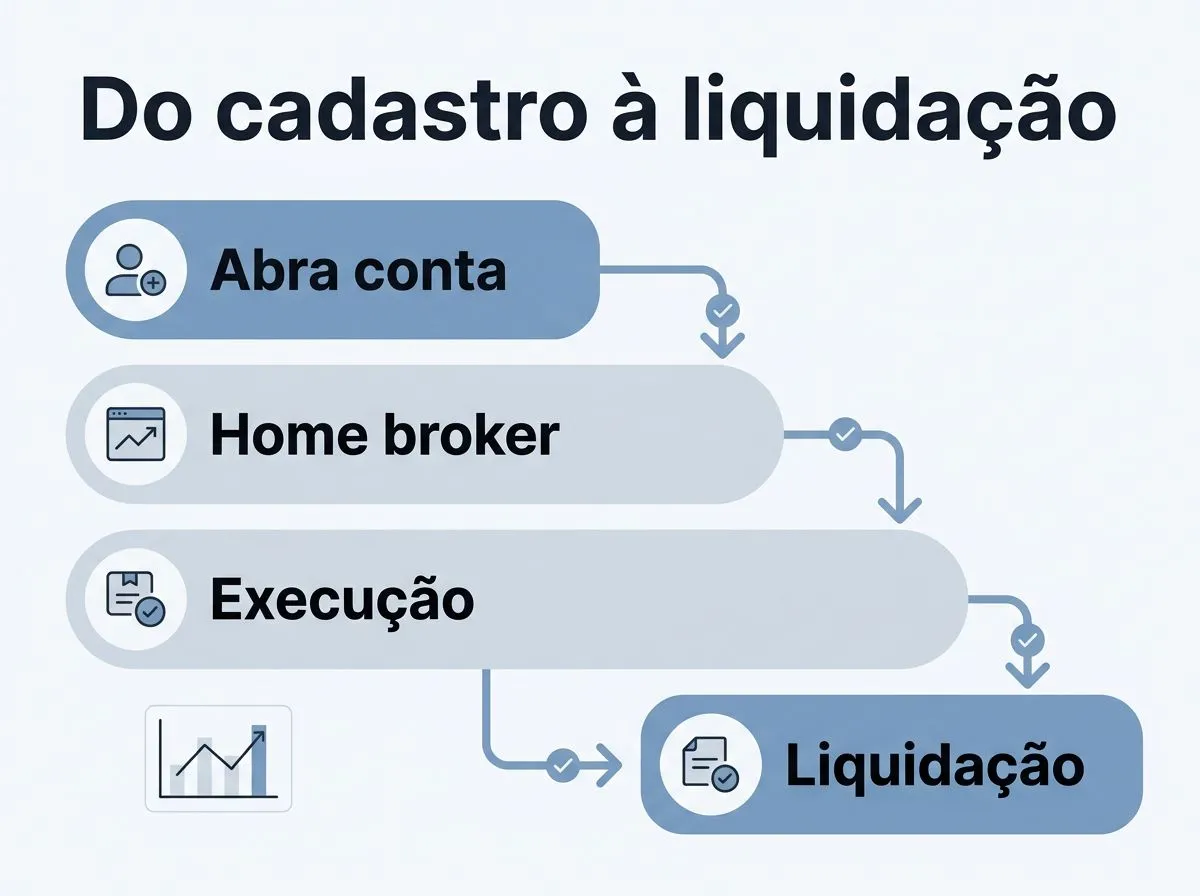
- Open an account with a brokerage firm and complete the registration process. At this stage, the institution verifies your information and gives you access to its trading platform.
- Access your broker’s trading platform or investment section. There, you can choose the asset, set the quantity, price, duration, and order type, when the platform allows it.
- Submit a buy or sell order. The brokerage forwards your instruction to the exchange’s system, where it enters the order book.
- Wait for the order to execute. An order becomes a trade only when it finds a compatible counterparty, in whole or in part, at the specified price and under the defined conditions.
- Track settlement and custody. After the trade, B3 processes the delivery of the asset to the buyer and payment to the seller, while recording the asset in custody.
The process follows a clear sequence, but each step affects the transaction in a different way.
- Account registration enables trading
- submitting the order takes your intent to the market
- execution turns that intent into a trade
- settlement completes the transaction financially and records ownership of the asset
For stocks, the CVM Investor Guide says settlement takes place two business days after the trading day, known as T+2.
That timing matters because the money and the asset don’t change hands the instant an order is placed. Beginners often think they’ve fully “bought” the stock and can use it as if it were already reflected in the final account statement. The transaction still has to pass through clearing and settlement. Put simply, execution is when the price is agreed on; settlement is when the delivery actually occurs.
What happens during the trading session: price, order book, and execution
The order book is the public queue of buy and sell intentions. It shows who wants to buy, who wants to sell, and the price each side is willing to accept. That’s where the market price takes shape. There’s no fixed price table. The price comes from buyers and sellers meeting at that moment.
Submitting an order doesn’t turn it into a trade automatically. It enters the order book and waits for a matching order on the other side. If someone is willing to sell at the price you’re ready to pay, or buy at the price you’re ready to accept, the order executes. If no match is available, it can remain pending until a counterparty appears or the order expires under its specified time in force.
That’s why an “executed” order and a “submitted” order aren’t the same thing. A submitted order is simply an instruction. An executed order has found a counterparty and left the order book, while a pending order is still open in the system. Market orders, limit orders, and other order types affect how matching happens, but the basic rule stays the same: a trade requires matching price and quantity.
In practice, this is why more liquid assets usually execute more smoothly, while less-traded assets can have wider spreads and more volatility in the order book. Beginners often look only at the last price and overlook the available order depth. What actually determines execution is the live queue of orders at that moment, not the number on the screen, which isn’t a guaranteed price.
Equities and fixed-income investments traded on the exchange: what belongs in each category
| Category | Examples traded | Price movement and return | Main risk | Where they are typically accessed |
|---|---|---|---|---|
| Equities | Stocks, real estate investment funds, ETFs, and other listed assets | Price fluctuates based on the market, company performance, interest rates, and expectations | Price volatility and the possibility of short-term losses | Brokerage firm, online trading platform, and the B3 exchange |
| Fixed income | Some bonds and other fixed-income securities may be traded in the secondary market, in addition to offerings distributed by intermediaries | The return tends to be known when the investment is purchased or tied to an index, but the price may fluctuate if the security is traded before maturity | Credit risk, mark-to-market risk, and liquidity risk | Brokerage firm, investment platform, and the secondary market when trading is available |
The stock exchange is most closely associated with equities, but it can also serve as a venue for trading certain fixed-income securities in the secondary market. That’s where the confusion usually starts. Fixed income doesn’t mean “no price fluctuations,” and an exchange doesn’t mean “stocks only.” The key difference is how the asset’s price and return behave, not simply where it appears.
Stock prices change constantly because the market is continually reassessing the company, its industry, and the broader economic cycle.
With fixed-income investments, the interest rate or compensation formula may be established from the beginning. The market price can still move before maturity, especially if the investor decides to sell early.
The practical effect is clear: people who value predictability usually pay closer attention to an investment’s cash flow and time to maturity. Investors who can accept volatility in pursuit of potential appreciation tend to focus more on the behavior of equities.
For beginners, the decision usually comes down to two factors: goals and time horizon. If the money can remain invested for longer and the investor can tolerate watching prices move up and down, equities may be a reasonable choice.
If the priority is understanding how returns are generated and limiting exposure to daily price swings, fixed income is often a more comfortable place to start. The common mistake is treating the two as interchangeable, as though the stock market meant only stocks or every fixed-income investment were protected from market movements.
What investors need to decide before placing a trade
Before placing a first order, investors need to make three practical decisions. First, choose a brokerage by looking at trading commissions, custody fees, platform quality, and whether it offers the product they want to trade. Next, decide whether the broker’s mobile or desktop platform is enough, or whether a more comprehensive platform with additional tools makes sense. Finally, keep short-term money separate from funds that can be exposed to market fluctuations.
A brokerage fee becomes part of the operation’s final cost, and that matters even more when the order is small. If the platform freezes or proves difficult to use, you’ll notice the problem at exactly the wrong time, when prices are moving quickly. Using emergency savings to buy an equity investment creates another issue: the risk starts affecting personal cash flow, not just the portfolio. That’s where the stock market stops being theory and becomes a personal financial decision.
The bottom line is simple: understanding how the stock market works lets you trade with less confusion and guesswork. B3 organizes the market, the brokerage routes the order, the order book determines the price, and settlement completes the transaction. Then come the decisions that have the biggest impact, including which asset to choose, how long to stay invested, and how much volatility you can handle.
Frequently asked questions
Do I need to speak with someone at the brokerage to place an order?
No. In general, you place the order through the brokerage’s digital platform, such as its online trading platform, and the brokerage sends it to B3’s trading system. The article also makes clear that the brokerage is the investor’s gateway to the market, so you don’t need to speak with someone to place a trade.
Is every order sent to the stock market executed immediately?
No. An order becomes a trade only when it finds a compatible counterparty in the order book, with prices and quantities that match. If that doesn’t happen right away, the order may remain pending until someone takes the other side or until it expires, depending on the selected time-in-force.
After I buy a stock, does the money leave my account immediately?
No. The purchase settles after the trade. For stocks, the article cites a T+2 settlement period, which means two business days after the trading session. Until settlement is complete, the position already appears in custody, but the financial transaction is still being processed.
Is the stock market the same thing as equities?
No. The stock market is the venue where assets are traded, while equities are an investment category whose prices can fluctuate. Stocks are the best-known example, but the article also cites ETFs and real estate investment funds as assets that follow this same logic.
Can I buy fixed-income investments through the stock market?
Yes, in some cases. The article explains that certain fixed-income securities and instruments may appear in the secondary market or in offerings distributed by intermediaries, depending on the product. The important point is that fixed income doesn’t mean the investment can’t fluctuate, especially when you sell before maturity.