
How to Start an Inventory-Free E-Commerce Business (Dropshipping): Complete Guide
Dropshipping pode ser uma porta de entrada para o e-commerce sem exigir a compra de estoque antes da venda. Mas a operação só se sustenta quando pedidos, prazos prometidos, margens e atendimento ao cliente estão alinhados. Se o plano for apenas cadastrar produtos e rodar anúncios, o dinheiro pode sumir rapidamente. Este guia aborda o modelo sem estoque próprio e com operação doméstica. Lojas que mantêm estoque, consórcios de fornecedores ou marketplaces com fulfillment próprio seguem outra lógica.
Key takeaways
- The order should only be sent to the supplier after payment is confirmed, to avoid costs from sales that will later be canceled.
- Domestic shipping times of 3 to 10 business days and international shipping times exceeding 40 days change your ads, checkout, and customer service.
- Pricing must start with the total delivered cost, including the product, shipping, fees, and taxes, rather than the listed price.
- A catalog with high shipping costs, frequent returns, and limited delivery predictability tends to eat into your margin faster.
- Before opening the store, validate payment processing, refunds, tracking, tax documents, and your return policy.
How the order process works in dropshipping
- The customer checks out and pays in your store. The first task is simple: receive payment confirmation before sending any order to the supplier. Without this check, you risk buying or forwarding an order that will be canceled later, creating unnecessary work and costs.
- You send the order to the supplier, either automatically or manually. On platforms such as Shopify and Loja Integrada, and with integrations for Dropi, Kargu, Rework, Importify, or Yampi, this process can be semi-automated. The practical point is the same: the product listing must match the variants, inventory, and delivery address; when this fails, the error shows up in the right package but with the wrong customer.
- The supplier picks and ships the order, and the tracking number is sent back to the store. The store then clearly communicates with the customer, preferably through the order dashboard and by email. This step may seem bureaucratic, but it reduces buyer anxiety and cuts down on repeated status-update messages to customer service.
- The difference between domestic and international shipping times changes the entire delivery promise. The research cites Kargu material as a practical reference of 3 to 10 business days for domestic shipping, with international shipping potentially taking more than 40 days. In practice, this affects your ad, checkout, and customer service policy: if the actual delivery time is long, the problem is not only logistics, but also a poorly communicated expectation.
How to choose a catalog and price products without losing margin
| Criterion | What to look for | Impact on price | Risk if ignored | Practical example | Potential for complaints or returns | Ease of restocking from the supplier |
|---|---|---|---|---|---|---|
| Total landed cost | Product price, shipping, taxes, platform fees, and payment processing fees | Sets the true minimum price | Selling at a loss even with strong sales volume | A low-cost item with expensive shipping may look attractive but eat up your margin at checkout | High if the customer perceives low value for the final price | Low if the supplier frequently changes shipping costs or fees |
| Restocking time | The time the supplier needs to pick, ship, and update the tracking information | Affects the delivery promise and the need to set aside a margin reserve | Refunds for delays and loss of trust | Products stored in a local warehouse usually allow for a more reliable delivery promise | Medium to high when delivery takes longer than agreed | High when the supplier maintains a stable catalog |
| Return potential | Fragility, size, visual expectations, and risk of buyer's remorse | Requires a larger margin cushion | The margin disappears through exchanges and customer support | Small accessories tend to be more predictable than apparel without a sizing guide | High for items that look different from the photo | Medium, depending on exchanges and return shipping |
| Dependence on paid advertising | How much the product depends on paid traffic to generate sales | Raises acquisition costs and puts pressure on the final price | Scaling without cash for ad spend | A commodity product facing heavy competition requires a lot of advertising, leaving little profit | Medium, but it increases dissatisfaction if delivery is delayed | High if the product is easy to restock and supply is stable |
| Compliance and restrictions | Whether the item has sales, shipping, or advertising restrictions | May require extra listing costs or catalog removal fees | Payment account or ad account suspension | High if the offer is unclear or prohibited | Low when the item depends on specific documentation |
Na prática, o preço precisa considerar o custo total da entrega, não apenas o valor informado pelo fornecedor. A Importify recomenda trabalhar com o landed cost, que inclui produto, frete, taxas e impostos incluídos, além de reservar uma margem para pequenas variações. Quando a conta começa no preço do produto e termina ali, a loja pode vender bastante e ainda ficar sem dinheiro no fim do mês.
O catálogo também exige critério. Produtos muito baratos costumam sentir mais o peso do frete, da publicidade e das reclamações. Já itens de maior valor geralmente absorvem melhor esses custos, desde que o prazo de entrega prometido seja confiável. Um erro clássico de iniciante é escolher um produto pela foto e só depois perceber que a conta deixou de fechar quando entram taxas, suporte e reembolsos.
Payments, refunds, and chargebacks: what needs to be in place
O pagamento precisa funcionar em conjunto com o restante da operação desde o primeiro dia. Se a loja aceita cartões, Pix e boleto, o gateway de pagamento e o back office devem mostrar com clareza o status de cada pedido. Afinal, o fornecedor só deve ser pago depois da confirmação do pagamento.
Em plataformas como a Stripe, a recomendação editorial é deixar visíveis a política de privacidade, as restrições dos produtos, o endereço físico quando aplicável e os termos de venda. Isso reduz atritos e aumenta a confiança do comprador.
Reembolso, reversão e chargeback não são a mesma coisa. O reembolso acontece quando a própria loja devolve o dinheiro, geralmente por arrependimento do comprador, atraso ou algum erro operacional.
A reversão cancela uma cobrança no cartão. Já o chargeback é uma contestação aberta pelo titular do cartão junto ao emissor. Normalmente, ele envolve custos extras, envio de documentos para contestar a disputa e risco para a reputação da loja.
Na prática, quanto mais demorado e menos transparente for o prazo de entrega, maior tende a ser a chance de disputa. O cliente começa a desconfiar antes mesmo de o pedido chegar.
O prazo de entrega tem um papel central nessa operação. A Rework observa que os atrasos alimentam disputas e desgastam o restante do negócio, porque cada chargeback exige tempo, comprovante de envio e acompanhamento. Prometer um prazo agressivo sem uma confirmação real do fornecedor é uma forma rápida de transformar uma venda em problema.
Para reduzir conflitos, o checkout e a página do produto precisam informar o essencial com clareza: prazo estimado de entrega, origem do envio, política de troca e canal de atendimento. Esconder essas informações para aumentar a conversão é um erro comum. Pode funcionar até surgir o primeiro atraso. Depois, a conta aparece em mensagens, chargebacks e pedidos de cancelamento.
Também vale manter tudo organizado, de preferência por pedido, data, status do pagamento, número de rastreamento, contato do cliente e eventuais exceções. Conforme a operação cresce, esse histórico pode ser o que separa uma solução em poucos minutos de uma busca interminável por informações espalhadas entre e-mails, planilhas e conversas de suporte.
Tax obligations and the minimum documents needed to operate safely
- Issue a tax invoice according to your operating model and applicable accounting guidance. If you sell as a business entity, invoicing and tax records need to align with your business activity and with how the product leaves the supplier.
- Organize the order and supplier data. Keep the customer's name, purchased item, amount, payment method, tracking information, shipping date, and the identity of the party responsible for fulfilling the shipment.
- Publish a privacy policy, terms of use, a physical address when applicable, and clear contact information. Shopify's documentation and Stripe's checklist agree on this point: transparency reduces operational risk and helps the platform view the store as legitimate.
- Review product restrictions before adding items to your catalog. Some products require extra care with shipping, advertising, documentation, or market compliance, and that cannot be fixed after the campaign is already running.
- Keep receipts, relevant conversations, registrations, and customer service history. If a dispute arises, this file supports the store's defense and keeps internal operations organized.
Validation checklist before opening the store
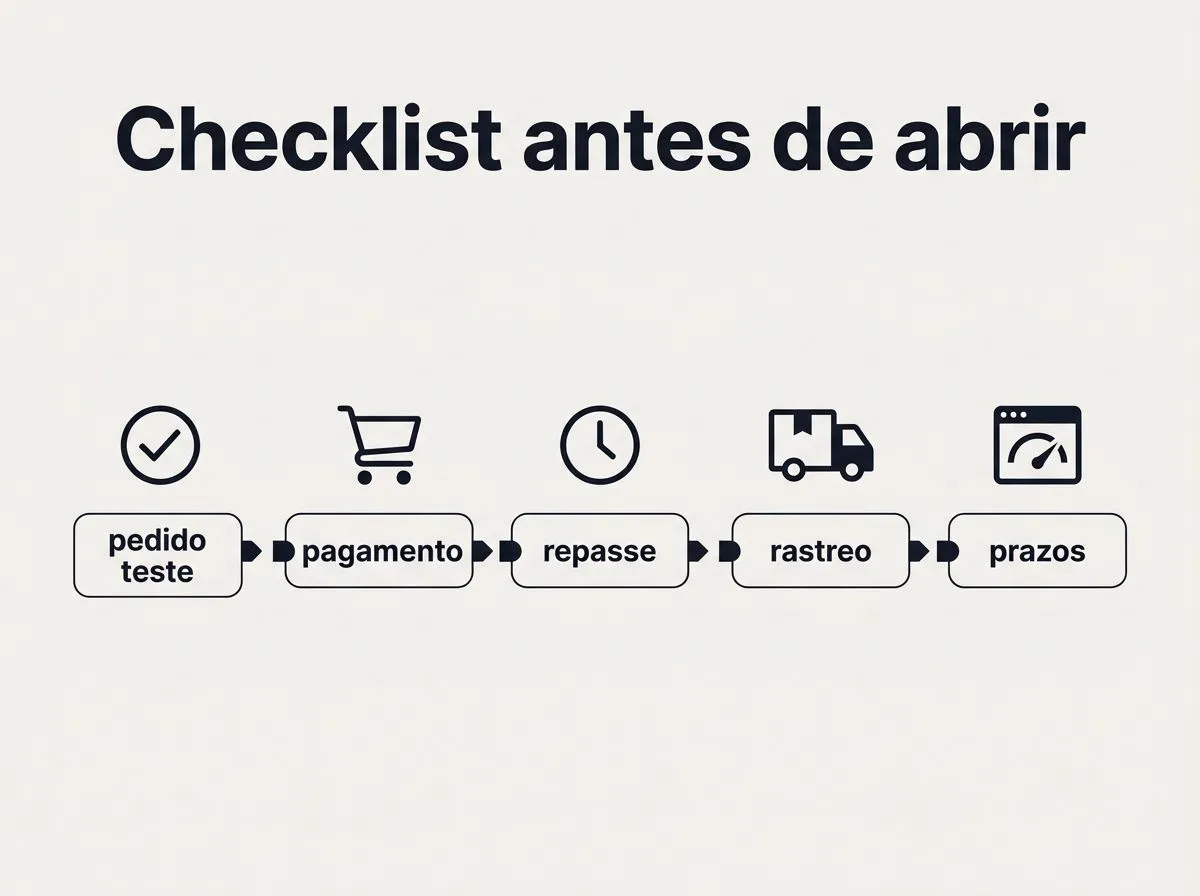
- Place an end-to-end order. Buy as a customer, track the payment, the payout, the shipment, and the arrival of the tracking information. If any step is confusing internally, the customer will feel it first.
- Confirm the actual delivery timeline with the supplier. Do not use the most optimistic estimate to make a sale. Use the timeline the supplier meets consistently, because a wrong promise turns into a cancellation.
- Review your exchange, return, and customer service policies. Customers need to know what happens if the product does not arrive, arrives incorrectly, or arrives after the agreed delivery date.
- Test the payment, shipping, and tracking integrations. Shopify, Loja Integrada, Yampi, and connectors such as Dropi, Kargu, Rework, and Importify only help if the flow is configured without breaks between order status updates and customer communications.
- Simulate a cancellation and a delay. Make sure someone on the team knows what to say, where to record the case, and how to refund the money without losing control of it.
Se você quer começar um negócio de e-commerce sem estoque, trate o dropshipping como uma operação, não como um atalho. Escolha poucos produtos, calcule o custo total entregue, publique prazos que o fornecedor realmente consiga cumprir, registre as regras de pagamento e reembolso e só depois invista em tráfego. Quem valida o processo antes de vender enfrenta menos surpresas, protege o fluxo de caixa e começa com mais controle.
Frequently asked questions
How long does a dropshipping order usually take to arrive?
Isso depende da localização do fornecedor e da rota de envio, mas o artigo apresenta uma referência prática: pedidos domésticos costumam chegar em 3 a 10 dias úteis, enquanto pedidos internacionais podem levar mais de 40 dias. Para a loja, o ponto principal é prometer somente o prazo que o fornecedor consegue cumprir de verdade. A diferença entre a expectativa e a entrega rapidamente vira reclamação.
Can I sell any product through dropshipping?
Não. Existem restrições legais, tributárias e das próprias plataformas, especialmente para categorias regulamentadas, produtos perigosos e itens sujeitos a exigências de importação ou rotulagem. O artigo também destaca que alguns produtos exigem verificações adicionais de conformidade antes de entrar no catálogo. Por isso, a escolha não pode se basear apenas na aparência ou no preço.
Can a customer request a refund before the product ships?
Sim, desde que a política da loja deixe isso claro. Na prática, o ponto principal é definir por quanto tempo os cancelamentos podem ser aceitos sem prejudicar o fluxo de caixa ou criar atritos com o fornecedor. Se o pedido ainda não foi encaminhado ao fornecedor nem enviado, normalmente é mais fácil resolver a situação.
What is the biggest mistake people make when starting an inventory-free business?
Prometer um prazo curto sem validar como a operação funciona de verdade. O artigo destaca que usar a estimativa mais otimista, em vez do prazo que o fornecedor cumpre com consistência, aumenta os cancelamentos, as reclamações e as disputas de pagamento. Quando a entrega atrasa, o problema deixa de ser apenas logístico. A confiança do cliente também entra em jogo.